TL;DR: Agentic coding stacks now cluster at three price points: $20, $100 and $200 a month. Claude Pro, Cursor Pro and ChatGPT Plus cost $20. Claude Max 5x, ChatGPT Pro 5x and Copilot Max cost $100. Claude Max 20x, ChatGPT Pro 20x and Cursor Ultra cost $200. OpenClaw is free software, so its bill is pure API spend: about $7 a day on Claude Sonnet 5 for a heavy 2M-in, 300K-out day, or $17.50 on Opus 5. At a $72 freelance hour, the $200 tier pays for itself after 2.8 saved hours a month.
The monthly plan table, checked September 4, 2026
Monthly, single-user figures from each vendor’s own page. Annual discounts noted where they exist.
| Stack | Tier | Price per month | What the tier buys |
|---|---|---|---|
| Claude (Claude Code) | Pro | $20 ($17 on annual, $200 up front) | Chat apps plus Claude Code in terminal and IDE, shared usage limits |
| Claude (Claude Code) | Max 5x | $100 | 5x Pro usage per 5-hour session, higher output limits |
| Claude (Claude Code) | Max 20x | $200 | 20x Pro usage per 5-hour session |
| Cursor | Hobby | $0 | Limited Agent requests, Composer access |
| Cursor | Pro | $20 | Extended Agent limits, frontier models, cloud agents |
| Cursor | Pro Plus | $60 | More included usage in both model pools |
| Cursor | Ultra | $200 | Most included usage, same two pools |
| Cursor | Teams | $40 or $120 per seat | Standard or Premium seat, Premium is 5x Standard Agent limits |
| ChatGPT (Codex) | Plus | $20 | Codex on web, CLI, IDE and iOS, GPT-5.6 family |
| ChatGPT (Codex) | Pro 5x | $100 | 5x Plus usage across ChatGPT and Codex |
| ChatGPT (Codex) | Pro 20x | $200 | 20x Plus usage, unlimited desktop voice |
| GitHub Copilot | Free | $0 | Limited chat and agent usage, 2,000 inline suggestions |
| GitHub Copilot | Pro | $10 | $15 of GitHub AI Credits ($10 base plus $5 flex) |
| GitHub Copilot | Pro+ | $39 | $70 of credits ($39 base plus $31 flex) |
| GitHub Copilot | Max | $100 | $200 of credits ($100 base plus $100 flex) |
| OpenClaw | Open source | $0 software | MIT licensed gateway, you supply the model API key |
Three things worth knowing. The $20 tier is a commodity: Claude, Cursor and OpenAI all charge exactly $20 and all ship a real coding agent at that price. Copilot is the only vendor that publishes the credit value behind the price: $15 of credits for $10, $200 for $100, a 1.5x to 2x multiplier in writing. And OpenClaw has no plan at all. The docs describe a self-hosted, MIT-licensed gateway connecting chat apps and a web dashboard to coding agents, and the only requirement beyond Node is “an API key from your chosen provider”. The provider directory lists Anthropic, OpenAI, Google, DeepSeek, xAI, OpenRouter and dozens more. Your bill is whatever those providers meter.
What each plan actually rations
The sticker price is the easy part. Usage is where the plans differ, and each vendor rations in a different unit.
Claude Pro and Max share one pool between chat and Claude Code. Anthropic’s Claude Code plan article is explicit: IDE and terminal usage count against the same limits as chat. Limits reset every five hours, Max adds a weekly cap, and at the wall you wait or pay API credits at metered rates.
Codex rations in messages per five hours. The Codex pricing docs put GPT-5.6 Sol at 10 to 100 local messages on Plus, 50 to 500 on Pro 5x and 200 to 2,000 on Pro 20x. Terra gets 25 to 200 on Plus, Luna 250 to 2,000. Cloud tasks run on Sol and burn faster.
Cursor rations in dollars. The models and pricing docs split included usage into a Cursor Models pool (Grok 4.6, Grok 4.5, Composer 2.5) and an Other Models pool where third-party models are “charged at the model’s API price”. Cursor’s own guidance: daily Agent users typically land at $60 to $100 a month total, power users at $200 or more. Teams and Enterprise add a Cursor Token Rate of $0.25 per million tokens on third-party models.
Copilot rations in credits, and the base credits on each tier equal the plan price, with the flex allotment on top. For the per-model API prices behind all these pools, the AI API pricing September 2026 roundup has every vendor on one page.
A heavy coding day on the API: the OpenClaw bill
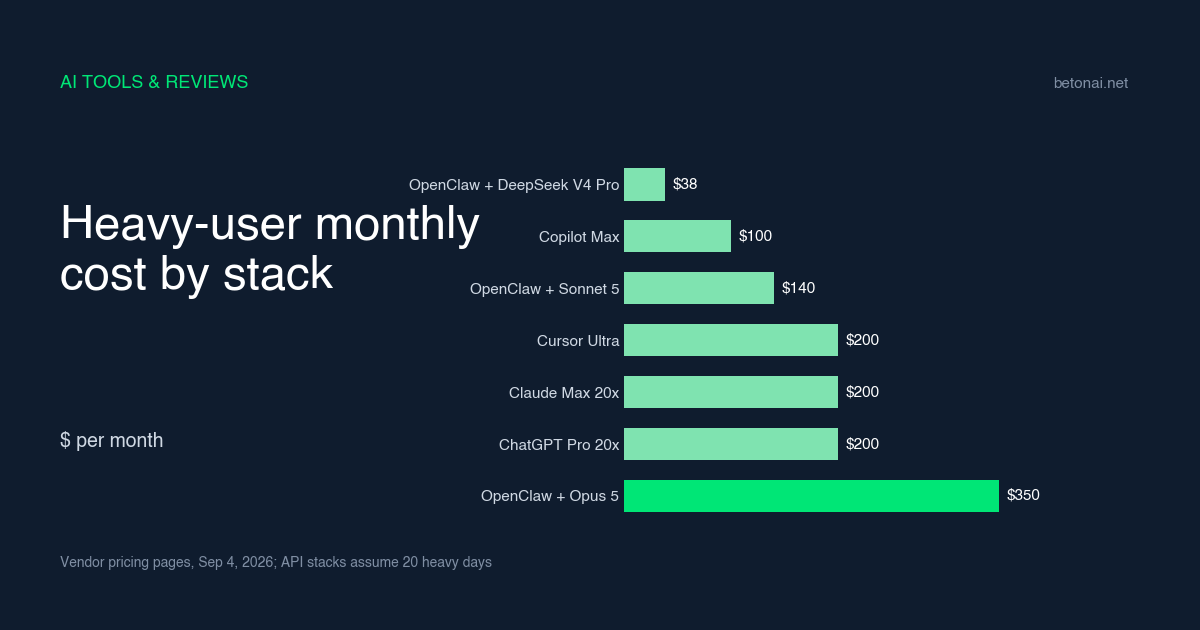
OpenClaw makes the metered cost visible, so here is a heavy agentic day on each model. Assumptions: 2,000,000 input tokens and 300,000 output tokens per day, no prompt caching, 20 working days a month. Agent sessions re-send context every turn, which is why input dwarfs output. List prices per 1M tokens, checked September 4, 2026.
| Model | Price ($ in / $ out per 1M) | Input cost per day | Output cost per day | Per day | Per month (20 days) |
|---|---|---|---|---|---|
| DeepSeek V4 Pro, off-peak | $0.66 / $1.98 | $1.32 | $0.59 | $1.91 | $38 |
| Gemini 3.8 Flash (promo to Dec 31) | $0.75 / $3.75 | $1.50 | $1.13 | $2.63 | $53 |
| Grok 4.6 | $2 / $6 | $4.00 | $1.80 | $5.80 | $116 |
| Claude Sonnet 5 | $2 / $10 | $4.00 | $3.00 | $7.00 | $140 |
| GPT-5.6 Terra | $2 / $12 | $4.00 | $3.60 | $7.60 | $152 |
| Gemini 3.1 Pro | $2 / $12 | $4.00 | $3.60 | $7.60 | $152 |
| GPT-5.6 Sol (promo to Nov 21) | $4 / $20 | $8.00 | $6.00 | $14.00 | $280 |
| Claude Opus 5 | $5 / $25 | $10.00 | $7.50 | $17.50 | $350 |
| GPT-5.5 | $5 / $30 | $10.00 | $9.00 | $19.00 | $380 |
| Claude Fable 5.1 | $10 / $50 | $20.00 | $15.00 | $35.00 | $700 |
| GPT-6 Astra | $10 / $50 | $20.00 | $15.00 | $35.00 | $700 |
Read the last column against the plan table. A heavy month on Opus 5 through the raw API is $350, 1.75x the price of Claude Max 20x. Fable 5.1 is $700, 3.5x. The $200 subscriptions are only worth $200 if you would otherwise run up an API bill above that. Anthropic’s Claude Code cost page puts the typical enterprise seat around $13 per active day and $150 to $250 per developer per month, with 90 percent of users under $30 a day (code.claude.com). The heavy-day assumption sits inside that band for Sonnet and Opus.
The flip side: below the heavy band, the API is cheaper. Sonnet 5 at $7 a day means ten agent days a month cost $70, under the $100 Max 5x price with no five-hour or weekly wall. For the cache rules that change this math, see the Anthropic API pricing guide.
What you actually pay: one OpenClaw month on Sonnet 5, with caching
Prompt caching is the lever plan users never see. Claude Code’s cost page shows a session with 91 percent of input served from cache. Here is the same heavy day at a conservative 80 percent cache hit rate on Sonnet 5, which bills cached input at $0.20 per 1M.
Uncached input: 20 percent of 2M is 400,000 tokens. 0.4 x $2 = $0.80.
Cached input: 1,600,000 tokens. 1.6 x $0.20 = $0.32.
Output: 300,000 tokens. 0.3 x $10 = $3.00.
Day total: $0.80 + $0.32 + $3.00 = $4.12. Month at 20 days: $82.40.
Without caching the month is $140. With it, $82.40, which undercuts Claude Max 5x by $17.60 with no session caps. Cache writes cost 1.25x base input on the first pass, a few cents per fresh context, and do not change the conclusion.
Same assumption on Opus 5 (cached input $0.50): 0.4 x $5 + 1.6 x $0.50 + 0.3 x $25 = $2.00 + $0.80 + $7.50 = $10.30 a day, $206 a month. That is within $6 of Claude Max 20x, so at Opus the subscription and the metered stack cost about the same, and the metered one has no rate limits and gives you a per-client cost line.
Break-even: the hourly rate that covers each stack
A tool pays for itself when monthly cost divided by hours saved is below your billable rate. Rate needed = monthly cost / hours saved.
| Stack | Monthly cost | Saves 2 h | Saves 5 h | Saves 10 h | Saves 20 h |
|---|---|---|---|---|---|
| Copilot Pro | $10 | $5.00/h | $2.00/h | $1.00/h | $0.50/h |
| Claude Pro, Cursor Pro or ChatGPT Plus | $20 | $10.00/h | $4.00/h | $2.00/h | $1.00/h |
| Cursor Pro Plus | $60 | $30.00/h | $12.00/h | $6.00/h | $3.00/h |
| Claude Max 5x, ChatGPT Pro 5x or Copilot Max | $100 | $50.00/h | $20.00/h | $10.00/h | $5.00/h |
| OpenClaw + Sonnet 5, 20 heavy days, no cache | $140 | $70.00/h | $28.00/h | $14.00/h | $7.00/h |
| Claude Max 20x, ChatGPT Pro 20x or Cursor Ultra | $200 | $100.00/h | $40.00/h | $20.00/h | $10.00/h |
| OpenClaw + Opus 5, 20 heavy days, no cache | $350 | $175.00/h | $70.00/h | $35.00/h | $17.50/h |
Now put real rates against it. The BetOnAI AI coding freelance rate card lists typical public rates of $40 an hour for LLM API integration, $72 for agent and workflow automation, $125 for senior ML engineering and $220 for fractional AI architecture.
At the agent-builder rate, $72 an hour: $200 / $72 = 2.78 hours. Save under three hours a month and the most expensive subscription tier is covered. The $350 Opus stack needs $350 / $72 = 4.86 hours. At $125 an hour, the $200 tier needs 1.6 hours and the $350 stack 2.8 hours.
For the hobbyist with no billable rate, the only number that matters is absolute spend: Copilot Free, Cursor Hobby, or OpenClaw on DeepSeek V4 Pro at under $2 a heavy day.
Where each stack leaks money
Every plan has a place where the bill quietly climbs.
Claude: the five-hour and weekly caps are the ceiling, and the overflow path is API credits at list price through Claude Code. Fable models on plans are also limited to a share of weekly limits per the pricing page.
Cursor: the Other Models pool bills at API price, and Teams add $0.25 per million tokens on top. A Pro user leaning on Opus-class models will be buying extra usage. For the user-side view, what Reddit really thinks about Cursor covers the usage-burn complaints.
Codex: Fast mode consumes credits faster and image generation burns the allowance 3 to 5x faster, per the Codex pricing docs. Run out and you buy credits or fall back to an API key at standard rates.
Copilot: the flex allotment “may change over time” on GitHub’s page, so plan around the base credits, which equal the plan price.
OpenClaw: no vendor cap means no vendor brake. A runaway agent loop on Fable 5.1 at $35 a day is your problem. Set a provider spend limit before anything else.
BetOnAI Verdict
Solo freelancer billing $72 an hour or more: pay for Claude Max 5x at $100 and stop there. It covers terminal and IDE agent work on one bill, breaks even at 1.39 saved hours a month at $72, and overflow to API credits is metered rather than blocked. If your clients live in GitHub pull requests, add Copilot Pro at $10 for $15 of credits. Total $110.
Small agency, three to ten seats: skip the $200 consumer tiers. Put every developer on Cursor Teams Standard at $40 and give seniors Claude Max 5x at $100, so $140 a seat. Then run one OpenClaw gateway on the agency’s own Anthropic key for shared automation and client bots: Sonnet 5 with caching is about $82 a heavy month, and every client gets a real cost line instead of a guess.
Hobbyist: Copilot Free plus Cursor Hobby cost nothing and cover most weekend projects. When that runs dry, OpenClaw with DeepSeek V4 Pro off-peak at $1.91 a heavy day, or Gemini 3.8 Flash at $2.63 through December 31, beats every $20 plan on a light schedule. Move to Claude Pro at $20 only when you want Claude Code and chat on one login.
Two moves: set a hard monthly spend cap at whichever API provider you use, and cancel any $20 plan you hold alongside a $100 or $200 plan from the same vendor. The higher tier already includes it.
Frequently Asked Questions
How much does Claude Code cost per month?
Claude Code is included in Claude Pro at $20 a month, Max 5x at $100 and Max 20x at $200, sharing one usage pool with chat. Run through the API instead, a heavy day of 2M input and 300K output tokens costs about $7 on Sonnet 5 or $17.50 on Opus 5, so $140 to $350 over 20 working days before caching.
Is Cursor or Claude Code cheaper for a freelancer?
At the $20 tier they cost the same. At the top, Cursor Ultra and Claude Max 20x are both $200. The difference is what they ration: Cursor bills third-party models at API price from a dollar pool, Claude caps usage per five-hour window. For a freelancer billing $72 an hour, either $200 tier pays for itself after 2.8 saved hours a month.
What does OpenClaw cost?
OpenClaw is MIT-licensed open source with no subscription. Its cost is the metered API spend on whichever provider you connect: about $38 a month on DeepSeek V4 Pro off-peak, $140 on Claude Sonnet 5 without caching, or $82 on Sonnet 5 with an 80% cache hit rate, for a heavy 20-day month.
Sources
- Anthropic, Claude plans and pricing: https://claude.com/pricing
- Anthropic Help Center, What is the Max plan: https://support.claude.com/en/articles/11049741-what-is-the-max-plan
- Anthropic Help Center, Use Claude Code with your Pro or Max plan: https://support.claude.com/en/articles/11145838-use-claude-code-with-your-pro-or-max-plan
- Anthropic, Claude Code cost management docs: https://code.claude.com/docs/en/costs
- Anthropic, Claude API pricing: https://platform.claude.com/docs/en/about-claude/pricing
- Cursor, pricing page: https://cursor.com/pricing
- Cursor, models and pricing docs: https://cursor.com/docs/models-and-pricing
- OpenAI, ChatGPT pricing: https://chatgpt.com/pricing
- OpenAI Help Center, What is ChatGPT Plus: https://help.openai.com/en/articles/6950777-what-is-chatgpt-plus
- OpenAI Help Center, About ChatGPT Pro tiers: https://help.openai.com/en/articles/9793128-about-chatgpt-pro-plans
- OpenAI, Codex pricing docs: https://learn.chatgpt.com/docs/pricing
- OpenAI, API pricing: https://developers.openai.com/api/docs/pricing
- GitHub, Copilot plans and pricing: https://github.com/features/copilot/plans
- OpenClaw, documentation home: https://docs.openclaw.ai/
- OpenClaw, provider directory: https://docs.openclaw.ai/providers
- Google, Gemini API pricing: https://ai.google.dev/gemini-api/docs/pricing
- DeepSeek, API pricing: https://api-docs.deepseek.com/quick_start/pricing
- xAI, models and pricing: https://docs.x.ai/docs/models
- BetOnAI, AI coding freelance rate card: https://betonai.net/ai-coding-is-the-highest-paying-freelance-skill-in-2026-heres-exactly-what-to-charge-real-rate-data/

Written by Nik Sai
BetOnAI Editorial covers AI tools, business strategies, and technology trends. We test and review AI products hands-on, providing real revenue data and honest assessments. Follow us on X @BetOnAI_net for daily AI insights.
How we score: read the methodology

BetOnAI Editorial covers AI tools, business strategies, and technology trends. We test and review AI products hands-on, providing real revenue data and honest assessments. Follow us on X @BetOnAI_net for daily AI insights.
More from Nik Sai