TL;DR: A 16-inch MacBook Pro with M5 Max and 128GB costs $6,999 after Apple’s June price hike. Amortised over 36 months plus electricity, it produces 1M output tokens for $6.57 at 30M tokens a month and $2.03 at 100M. That beats Claude Sonnet 5 ($10 out) past roughly 20M output tokens a month and Gemini 3.8 Flash’s promo price past 53M. It never beats GPT-5.6 Luna ($1.20 out) or DeepSeek V4 Flash ($0.66 off-peak): one Mac cannot physically produce enough tokens. Buy it for privacy, Sonnet-class volume, or to resell compute, not to save money on cheap models.
The hardware bill in September 2026
Apple raised Mac prices on June 25, 2026. 9to5Mac’s list puts the M5 Max MacBook Pro at $4,099, up from $3,599 at launch in March. The pain is in memory. John Gruber’s configurator table shows the 64GB upgrade on the 40-core M5 Max going from +$200 to +$400 and the 128GB upgrade from +$1,000 to +$2,000, both up 100%. The 16-inch stays +$300 over the 14-inch.
The apple.com 16-inch store page tiles the 40-core M5 Max with 48GB and 2TB at $4,999 (checked September 4, 2026). Apple’s August 25 Mac Studio release lists the M5 Max Studio from $2,499 (36GB, 512GB) and the M5 Ultra from $5,499 (96GB), shipping September 22.
| Machine (checked Sep 4, 2026) | Price | Per month, 24 mo | Per month, 36 mo |
|---|---|---|---|
| 16-inch MacBook Pro, M5 Max 40-core, 64GB, 2TB | $5,399 ($4,999 + $400) | $224.96 | $149.97 |
| 16-inch MacBook Pro, M5 Max 40-core, 128GB, 2TB | $6,999 ($4,999 + $2,000) | $291.63 | $194.42 |
| Mac Studio, M5 Max, 36GB, 512GB | $2,499 | $104.13 | $69.42 |
| Mac Studio, M5 Ultra, 96GB, 1TB | $5,499 | $229.13 | $152.75 |
Sanity check: $6,999 + $3,000 (8TB) + $150 (nano-texture) = $10,149, the maxed-out figure 9to5Mac reported.
Apple publishes only starting configurations for the Mac Studio, so the Studio rows use those. The rest of this piece uses the $6,999 128GB MacBook Pro, the machine in our M5 local AI guide, because 128GB is what runs a 26B to 35B model with a real context window.
What the M5 Max actually produces per hour
Separate measured from estimated.
Measured: the llama.cpp Apple Silicon performance thread lists the M5 Max 40-core GPU (614 GB/s) at 119.92 tokens/s text generation on a 7B model at Q4_0, 72.42 tokens/s at Q8_0, and 3,219.99 tokens/s prompt processing. The M4 Max 40-core scores 83.06 on the same test.
Estimated: the llmcheck.net benchmark index (updated August 25, 2026) lists Gemma 4 26B-A4B at 50 tokens/s on an M5 Max 128GB under MLX, Gemma 4 31B dense at 26, and Qwen 3.6-35B-A3B at 55. That site labels them as derived from a memory-bandwidth model, not lab runs: planning figures, not promises.
| Model on M5 Max 40-core | tokens/s | Status | Max output per 30-day month, single stream |
|---|---|---|---|
| 7B, Q4_0 (llama.cpp) | 119.9 | Measured | 311M |
| Gemma 4 26B-A4B, Q4 (MLX) | 50 | Estimate | 129.6M |
| Qwen 3.6-35B-A3B, Q4 (MLX) | 55 | Estimate | 142.6M |
| Gemma 4 31B dense, Q4 (MLX) | 26 | Estimate | 67.4M |
The last column kills most “the Mac is free after purchase” arguments. 50 tokens/s x 86,400 seconds x 30 days = 129.6M tokens, and that is every second of every day. Real usage lands far below it.
Cost per 1M output tokens on the Mac
Electricity first. The EIA Electric Power Monthly puts the U.S. residential average at 18.34 cents/kWh for June 2026. Wattage during generation is not published, so estimate it: Notebookcheck’s M5 Max review measured 13.3 W idle, a 70 W sustained chip limit and 150.3 W peak. Generation is a memory-bound GPU load, not a full stress test, so assume 90 W at the wall: 0.09 kW x $0.1834 = $0.0165 per hour.
At 50 tokens/s, 1M tokens takes 1,000,000 / 50 = 20,000 seconds = 5.56 hours, so electricity is 5.56 x $0.0165 = $0.09 per 1M output tokens. At 120 tokens/s it is $0.04; at 26 tokens/s, $0.18. Electricity is a rounding error; hardware is the whole story.
Cost per 1M output tokens = (hardware per month / monthly volume in M) + $0.09. For the $6,999 machine at 50 tokens/s:
| Output tokens per month | Hours of generation | Cost per 1M, 24 mo ($291.63/mo) | Cost per 1M, 36 mo ($194.42/mo) |
|---|---|---|---|
| 5M | 28 | $58.42 | $38.97 |
| 10M | 56 | $29.25 | $19.53 |
| 30M | 167 | $9.81 | $6.57 |
| 60M | 333 | $4.95 | $3.33 |
| 100M | 556 | $3.01 | $2.03 |
| 129.6M (24/7 ceiling) | 720 | $2.34 | $1.59 |
Read the 10M row twice: $19.53 per 1M on a 36-month Mac, against $10 for Sonnet 5 and $3.75 for Gemini 3.8 Flash. The Mac loses badly at hobbyist volume.
Break-even volume against each API
Set the Mac’s cost per 1M equal to each vendor’s output price and solve: V = hardware per month / (API output price – $0.09). Prices are from the vendor pages in our September API pricing roundup, checked September 4, 2026.
| API model | Output price per 1M | Break-even volume, 36 mo | Break-even volume, 24 mo | Reachable on one Mac at 50 tok/s? |
|---|---|---|---|---|
| Claude Sonnet 5 ($2 in / $10 out) | $10.00 | $194.42 / $9.91 = 19.6M | $291.63 / $9.91 = 29.4M | Yes, 5 to 8 hours a day |
| Gemini 3.8 Flash, 2027 price ($1.50 / $7.50) | $7.50 | $194.42 / $7.41 = 26.2M | 39.4M | Yes |
| Gemini 3.8 Flash, promo to Dec 31 ($0.75 / $3.75) | $3.75 | $194.42 / $3.66 = 53.1M | 79.7M | Yes, 12 to 18 hours a day |
| DeepSeek V4 Flash, peak ($0.44 / $1.32) | $1.32 | $194.42 / $1.23 = 158.1M | 237.1M | No, ceiling is 129.6M |
| GPT-5.6 Luna ($0.20 / $1.20) | $1.20 | $194.42 / $1.11 = 175.2M | 262.7M | No |
| DeepSeek V4 Flash, off-peak ($0.22 / $0.66) | $0.66 | $194.42 / $0.57 = 341.1M | 511.6M | No |
The bottom three rows are the headline. Even on the measured 7B model at 120 tokens/s (ceiling 311M, electricity $0.04), DeepSeek off-peak needs $194.42 / $0.62 = 313.5M tokens a month. Against sub-$1.50 output prices, local inference on Apple hardware is not a cost play in 2026.
Against Sonnet 5 the story flips at roughly 20M output tokens a month: a coding agent or content pipeline running several hours a day.
What you actually pay: a 30M-token month
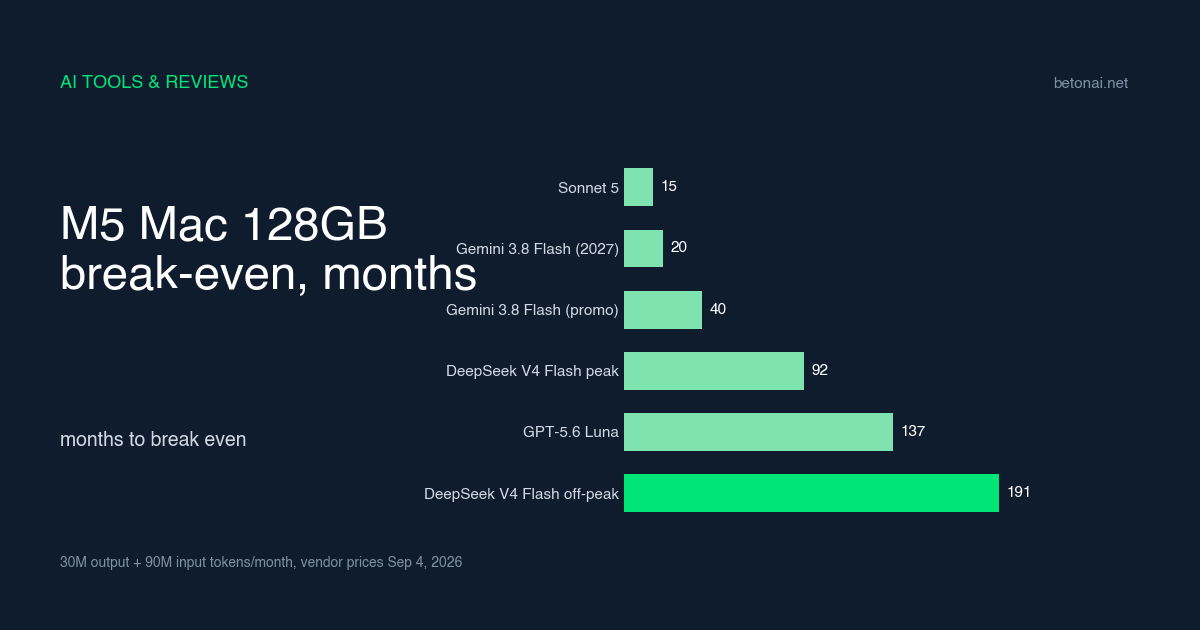
Output-only comparisons flatter the API: you pay for input too, and the Mac processes prompts for free. So run a realistic job, 30M output plus 90M input tokens a month, a 3:1 ratio typical of agent loops.
Mac side. Generation: 30M / 50 tokens/s = 166.7 hours. Prompt processing: 90M / 3,220 tokens/s (the measured 7B rate; a 26B MoE is slower, but this is a small term) = 7.8 hours. 174.5 hours x $0.0165 = $2.88 of electricity a month. Hardware: $6,999 once.
API side, per month, checked September 4, 2026:
- Sonnet 5: 90 x $2 + 30 x $10 = $180 + $300 = $480
- Gemini 3.8 Flash promo: 90 x $0.75 + 30 x $3.75 = $67.50 + $112.50 = $180
- Gemini 3.8 Flash from Jan 1, 2027: 90 x $1.50 + 30 x $7.50 = $135 + $225 = $360
- GPT-5.6 Luna: 90 x $0.20 + 30 x $1.20 = $18 + $36 = $54
- DeepSeek V4 Flash peak: 90 x $0.44 + 30 x $1.32 = $39.60 + $39.60 = $79.20
- DeepSeek V4 Flash off-peak: 90 x $0.22 + 30 x $0.66 = $19.80 + $19.80 = $39.60
Break-even months = $6,999 / (API monthly bill – $2.88 Mac electricity):
| API model | Monthly API bill | Break-even months | 36-month total, API | 36-month total, Mac |
|---|---|---|---|---|
| Claude Sonnet 5 | $480.00 | $6,999 / $477.12 = 14.7 | $17,280 | $7,103 |
| Gemini 3.8 Flash (2027 price) | $360.00 | $6,999 / $357.12 = 19.6 | $12,960 | $7,103 |
| Gemini 3.8 Flash (promo) | $180.00 | $6,999 / $177.12 = 39.5 | $6,480 | $7,103 |
| DeepSeek V4 Flash peak | $79.20 | $6,999 / $76.32 = 91.7 | $2,851 | $7,103 |
| GPT-5.6 Luna | $54.00 | $6,999 / $51.12 = 136.9 | $1,944 | $7,103 |
| DeepSeek V4 Flash off-peak | $39.60 | $6,999 / $36.72 = 190.6 | $1,426 | $7,103 |
The Mac’s 36-month total is $6,999 + 36 x $2.88 = $7,103. Against Sonnet 5 you finish $10,177 ahead. Against Luna, $5,159 behind. Against DeepSeek off-peak, $5,677 behind, and 190 months is a 16-year payback on a laptop.
One adjustment moves Sonnet’s number. Anthropic’s price list has Sonnet 5 cached input at $0.20. If 80% of that 90M input hits cache: 72 x $0.20 + 18 x $2 + $300 = $350.40 a month, and break-even stretches to $6,999 / $347.52 = 20.1 months. Still inside a 24-month laptop life.
The quality caveat: which jobs a local model can take
Every number above assumes the local model does the job as well as the API model. It does not, and pretending otherwise is how people buy a $6,999 laptop and keep paying for Sonnet anyway.
Gemma 4 26B-A4B at 4-bit is a capable mid-tier model. It is not Sonnet 5, and it is nowhere near Opus 5 or Fable 5.1. Its fair quality peers are Gemini 3.8 Flash, GPT-5.6 Luna and DeepSeek V4 Flash, precisely the models the Mac cannot beat on cost. So the honest framing: you pay a hardware premium for privacy, offline access and zero per-token anxiety, and the Sonnet-beating math only holds for tasks you were overpaying Sonnet for anyway.
Fit for a local 26B to 35B model in 2026:
- Summarising, tagging and classifying documents you cannot send to a third party
- First drafts, rewrites, and translation between major languages
- Retrieval-augmented Q&A over your own files
- Routine code completion, boilerplate, tests, and log triage
- High-churn, low-reasoning agent loops: scrapers, formatters, extractors
Still belongs on Sonnet 5 or above: multi-step reasoning where a wrong step costs money, large refactors, anything you would have sent to Opus or Fable anyway.
The winning setup is both: local for the churn, API for the judgement. It is also why the M5 compute rental play works. Idle hours on a machine you already own are the only tokens that are truly free.
BetOnAI Verdict
Hobbyist, under 10M output tokens a month. Do not buy the Mac for AI. At 10M tokens a 36-month M5 Max 128GB costs $19.53 per 1M against $10 for Sonnet 5 and $3.75 for Gemini 3.8 Flash. Put $200 a month into API credits, get a better model, keep the $6,999.
Solo builder on Sonnet-class work, 20M to 60M output tokens a month. This is the buy zone. At 30M output plus 90M input the Mac pays back against Sonnet 5 in 14.7 months, or 20.1 with aggressive caching. Move the churn to Gemma 4 or Qwen 3.6 locally, keep Sonnet 5 for the hard steps, and expect the API bill to halve rather than vanish.
Anyone already on Luna or DeepSeek V4 Flash. Stay on the API. Break-even is 137 to 191 months and the hardware ceiling is 129.6M tokens a month. No Apple configuration changes that in 2026.
Privacy-bound teams. The cost math is irrelevant; you are buying the right not to send data out. Take the 128GB over the 64GB for $1,600 more; the second 64GB is what runs the 26B to 35B class with real context.
The action list:
- Before buying, pull last month’s API invoice and count output tokens. Under 20M, close the tab.
- If you buy, amortise over 36 months and run Gemma 4 26B-A4B or Qwen 3.6-35B-A3B under MLX, not Ollama; llmcheck’s index has MLX 20% to 50% faster on M5.
- Rent the idle hours. A machine that breaks even in 14.7 months against Sonnet 5 breaks even faster when someone else pays for the nights.
Frequently Asked Questions
Is it cheaper to run AI locally on a Mac or use an API?
Only at high volume against mid-priced models. A $6,999 M5 Max MacBook Pro with 128GB produces 1M output tokens for about $6.57 a month at 30M tokens on a 36-month amortisation, which beats Claude Sonnet 5 at $10 past roughly 20M output tokens a month. It never beats GPT-5.6 Luna at $1.20 or DeepSeek V4 Flash at $0.66 because one Mac cannot generate enough tokens.
How many tokens per second does an M5 Max Mac generate?
The llama.cpp benchmark thread lists 119.92 tokens per second on a 7B model at Q4_0 for the 40-core M5 Max. Estimates for Gemma 4 26B-A4B under MLX are about 50 tokens per second, which caps a single machine at roughly 129.6M output tokens a month running around the clock.
What is the break-even period for buying a Mac for local AI?
At 30M output plus 90M input tokens a month, the $6,999 Mac pays back against Claude Sonnet 5 in 14.7 months, against Gemini 3.8 Flash at its 2027 price in 19.6 months, and against GPT-5.6 Luna in 137 months. Under 10M output tokens a month, API credits are the better buy.
Sources
- Apple Store: https://www.apple.com/shop/buy-mac/macbook-pro/16-inch
- Apple Newsroom, March 3, 2026: https://www.apple.com/newsroom/2026/03/apple-introduces-macbook-pro-with-all-new-m5-pro-and-m5-max/
- Apple Newsroom, August 25, 2026: https://www.apple.com/newsroom/2026/08/apple-introduces-new-mac-studio-with-m5-max-and-m5-ultra/
- Apple Support, 16-inch tech specs: https://support.apple.com/en-us/126319
- 9to5Mac, June 25, 2026: https://9to5mac.com/2026/06/25/apple-price-increases-mac-ipad-more/
- 9to5Mac, June 29, 2026: https://9to5mac.com/2026/06/29/a-maxed-out-16-inch-macbook-pro-now-has-a-5-figure-price-tag/
- Daring Fireball, June 25, 2026: https://daringfireball.net/2026/06/spensive_thoughts
- ggml-org llama.cpp, discussion #4167: https://github.com/ggml-org/llama.cpp/discussions/4167
- llmcheck.net, updated August 25, 2026: https://llmcheck.net/benchmarks
- Notebookcheck, August 27, 2026: https://www.notebookcheck.net/Apple-s-fastest-laptop-starts-to-show-its-age-Apple-MacBook-Pro-16-2026-M5-Max-Review.1250821.0.html
- U.S. Energy Information Administration, Table 5.6.A: https://www.eia.gov/electricity/monthly/epm_table_grapher.php?t=epmt_5_6_a
- Anthropic: https://platform.claude.com/docs/en/about-claude/pricing
- OpenAI: https://developers.openai.com/api/docs/pricing
- Google: https://ai.google.dev/gemini-api/docs/pricing
- DeepSeek: https://api-docs.deepseek.com/quick_start/pricing

Written by Nik Sai
BetOnAI Editorial covers AI tools, business strategies, and technology trends. We test and review AI products hands-on, providing real revenue data and honest assessments. Follow us on X @BetOnAI_net for daily AI insights.

BetOnAI Editorial covers AI tools, business strategies, and technology trends. We test and review AI products hands-on, providing real revenue data and honest assessments. Follow us on X @BetOnAI_net for daily AI insights.
More from Nik Sai