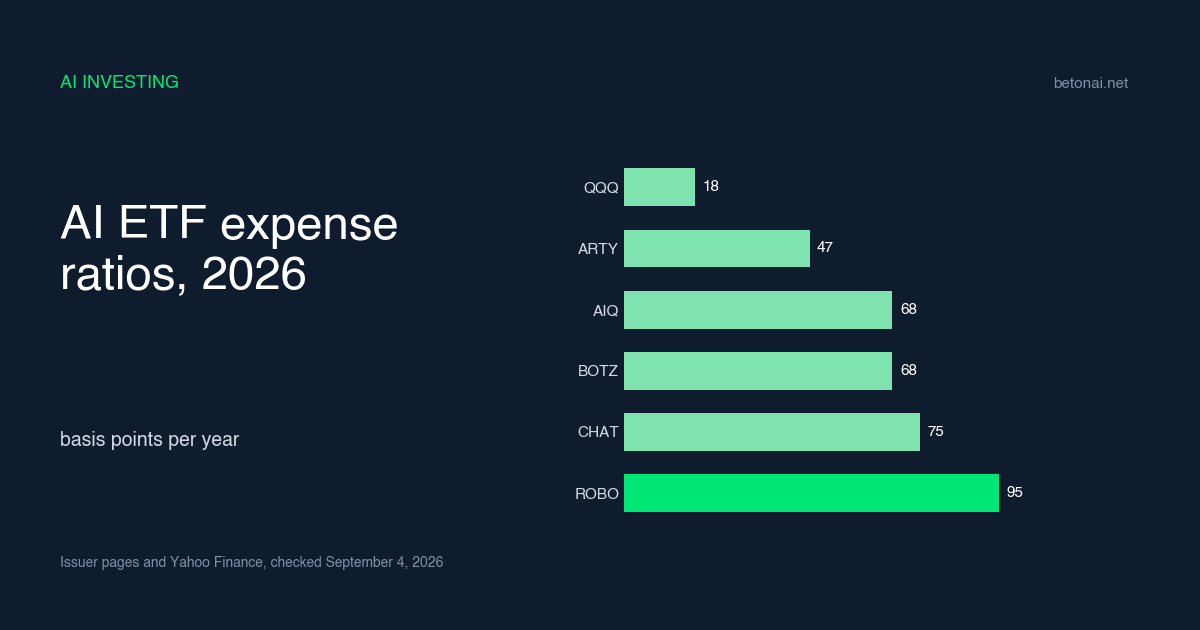
TL;DR: The six most-searched AI and tech ETFs charge between 0.18% (QQQ) and 0.95% (ROBO) a year. On $10,000 over 10 years at 8% gross growth, that fee gap is worth $1,468 in lost value. Year to date, the ETFs range from 0.89% (BOTZ) to 54.86% (ARTY), and the five big AI stocks range from 3.58% (AVGO) to 113.00% (AMD). Most of the “AI” ETFs put 12% to 27% of assets into the same five mega-caps you could buy for free. Pay the fee only when the fund holds something you cannot buy yourself: Japanese robotics names, Korean memory, Taiwanese chip designers. Checked September 4, 2026.
The six ETFs, side by side
Every figure below links to the page it came from. Expense ratios and holdings counts are from the issuer where the issuer publishes them, otherwise from a quote page, as noted. Year-to-date (YTD) and one-year returns are the Performance Overview numbers on each Yahoo Finance quote page, which carry their own as-of date.
| Ticker | Fund | Expense ratio | Holdings | Net assets | YTD return (as of) | 1-year return |
|---|---|---|---|---|---|---|
| QQQ | Invesco QQQ Trust (Nasdaq-100 benchmark) | 0.18% | 105 | $483.54B | 15.46% (Sep 1, 2026) | 24.65% |
| ARTY | iShares Future AI & Tech ETF (formerly IRBO) | 0.47% | 66 | $3.90B | 54.86% (Aug 28, 2026) | 71.72% |
| AIQ | Global X Artificial Intelligence & Technology ETF | 0.68% | 88 | $10.15B | 26.43% (Aug 31, 2026) | 42.76% |
| BOTZ | Global X Robotics & Artificial Intelligence ETF | 0.68% | 61 | $3.40B | 0.89% (Aug 31, 2026) | 7.49% |
| CHAT | Roundhill Generative AI & Technology ETF (active) | 0.75% | 49 | $1.80B | 49.05% (Aug 10, 2026) | 67.98% |
| ROBO | ROBO Global Robotics & Automation Index ETF | 0.95% | 92 | $2.03B | 22.38% (Aug 17, 2026) | 34.03% |
Three observations.
First, fee and return are not correlated here. QQQ at 0.18% returned 15.46% YTD. ROBO at 0.95% returned 22.38%. ARTY at 0.47% returned 54.86%. Treat the fee as a separate decision from the exposure.
Second, AIQ and BOTZ share an issuer and an identical 0.68% fee and are 25 percentage points apart YTD. “AI ETF” tells you nothing about what you own. The holdings list does.
Third, the Yahoo as-of dates are not uniform (CHAT August 10, ROBO August 17, QQQ September 1). Read the returns as a snapshot with a three-week smear, not a single-day league table.
The five stocks, side by side
Same source, same method: Yahoo Finance Performance Overview, trailing total returns as of September 3, 2026, which the page states may include dividends.
| Ticker | Company | YTD return | 1-year return | Beat S&P 500 YTD (13.18%)? |
|---|---|---|---|---|
| AMD | Advanced Micro Devices | 113.00% | 181.35% | Yes, by 99.82 points |
| NVDA | NVIDIA | 22.64% | 34.07% | Yes, by 9.46 points |
| GOOGL | Alphabet | 9.56% | 48.90% | No, short by 3.62 points |
| MSFT | Microsoft | 6.15% | 1.77% | No, short by 7.03 points |
| AVGO | Broadcom | 3.58% | 18.98% | No, short by 9.60 points |
For reference, the same Yahoo pages show the S&P 500 at 13.18% YTD and 20.15% over one year as of September 3, 2026.
Now the number that matters. An equal-weight basket of these five stocks bought on January 1 would be up 30.99% YTD: (113.00 + 22.64 + 9.56 + 6.15 + 3.58) / 5. Take AMD out and the remaining four average 10.48%: (22.64 + 9.56 + 6.15 + 3.58) / 4. That is below the S&P 500. One stock did the work. Microsoft, the most-owned “AI stock” on the planet, has returned 1.77% over the past year.
This is the honest case for an ETF: you would not have known in January that AMD was the one. The honest case against: the ETFs that held enough AMD to benefit (ARTY at 4.27%, CHAT at 3.07%) are the ones that charge you 47 to 75 basis points for the privilege.
What you actually pay: $10,000 for 10 years
Expense ratios look tiny. They are not. Two ways to see it.
Flat method (no growth). Fee per year on $10,000 = $10,000 x expense ratio. Times 10 years:
| ETF | Expense ratio | Fee per year | 10-year total (no growth) |
|---|---|---|---|
| QQQ | 0.18% | $10,000 x 0.0018 = $18 | $180 |
| ARTY | 0.47% | $10,000 x 0.0047 = $47 | $470 |
| AIQ | 0.68% | $10,000 x 0.0068 = $68 | $680 |
| BOTZ | 0.68% | $10,000 x 0.0068 = $68 | $680 |
| CHAT | 0.75% | $10,000 x 0.0075 = $75 | $750 |
| ROBO | 0.95% | $10,000 x 0.0095 = $95 | $950 |
Compounding method (assumes 8% gross return every year, which is an assumption, not a forecast). With no fee, $10,000 x 1.08^10 = $21,589. With a fee, the growth rate is 8% minus the expense ratio:
| ETF | Net rate | $10,000 x (1 + net rate)^10 | Value lost to fees |
|---|---|---|---|
| QQQ | 7.82% | $21,232 | $357 |
| ARTY | 7.53% | $20,668 | $921 |
| AIQ | 7.32% | $20,268 | $1,321 |
| BOTZ | 7.32% | $20,268 | $1,321 |
| CHAT | 7.25% | $20,136 | $1,453 |
| ROBO | 7.05% | $19,764 | $1,826 |
The gap between QQQ and ROBO on the same $10,000 is $1,468 over a decade, on the 8% assumption. The gap between owning five stocks directly at a zero-commission broker and owning ROBO is the full $1,826. Scale it: at $100,000 the ROBO drag is $18,256. This is money leaving your account every year regardless of whether the fund goes up or down. BOTZ charged 0.68% to return 0.89% YTD. Almost half the year’s gain went to the manager.
Overlap: how much of each ETF is the same five stocks
If an AI ETF is mostly NVDA, MSFT, GOOGL, AMD and AVGO, you are paying a manager to buy stocks you could buy in four clicks. Weights below are from the stockanalysis.com top-25 holdings lists, as-of date in brackets. A dash means the stock is not in the fund’s top 25, so its weight is below the 25th holding’s weight.
| ETF (holdings as of) | NVDA | MSFT | GOOGL | AMD | AVGO | Five-stock total |
|---|---|---|---|---|---|---|
| QQQ | 8.73% | 5.94% | 6.06% (GOOGL 3.14% + GOOG 2.92%) | 3.40% | 2.79% | 26.92% |
| CHAT (Aug 14, 2026) | 6.43% | 2.65% | 5.13% | 3.07% | 4.12% | 21.40% |
| ARTY (Sep 3, 2026) | 4.89% | 3.29% | – | 4.27% | 4.28% | 16.73% |
| AIQ (Aug 14, 2026) | 2.95% | 3.55% | 2.97% | 2.60% | 2.73% | 14.80% |
| BOTZ (Aug 14, 2026) | 9.37% | – | 2.19% | – | – | 11.56% |
| ROBO (Aug 13, 2026) | – | – | – | – | – | 0.00% |
Set that against the fee table.
QQQ is 26.92% those five names at 0.18%. That is the cheapest way to hold the mega-cap AI trade with 100 other names as ballast. If your “AI exposure” is really “I want NVDA plus the big platforms,” QQQ does it for $18 a year per $10,000.
CHAT is 21.40% the same five at 0.75%. You pay four times QQQ’s fee and one fifth of the fund is stuff you already own if you own QQQ. What you get for the extra 57 basis points is the other 78.60%: Nebius at 3.48%, SK hynix at 3.47%, CoreWeave at 3.41%, Micron at 3.32%, Samsung at 3.02%, ASML at 2.74%. That is a genuine active bet on AI infrastructure outside the mega-caps, and it has paid: 49.05% YTD.
ARTY is the interesting one. Only 16.73% in the five, and its top holdings are TSMC 4.87%, Micron 4.48%, Super Micro 4.11%, Global Unichip 3.95%, NAVER 3.73%, CoreWeave 3.62%. Half the fund is Asia-listed semiconductor and memory names most US brokerage accounts cannot buy directly. 0.47% for that is defensible. 54.86% YTD says the index picked the right corner of the market this year.
BOTZ and ROBO barely touch the five. BOTZ is Keyence 10.81%, ABB 9.14%, Fanuc 7.78%, Intuitive Surgical 6.06%, SMC 4.72% plus 9.37% NVDA: industrial automation with one chip stock bolted on. Its 0.89% YTD says factory robotics sat out this year’s AI rally. ROBO is a 92-name basket where the largest position is Zebra Technologies at 1.90% and none of the five mega-caps make the top 25. It earned its 0.95% this year with 22.38% YTD, but it is the highest fee in the group for the least AI-specific portfolio.
AIQ is the odd case: 88 holdings, Palantir 3.85% at the top, the five mega-caps spread evenly at 2.60% to 3.55% each, and a beta of 1.93 versus the S&P 500. It is a higher-volatility QQQ at nearly four times the cost.
When the fee is worth it
An expense ratio buys you three things: access, selection and rebalancing. Pay for it only when at least one of them is real.
Pay when you cannot buy the holdings yourself. ARTY’s TSMC (Taipei listing), Global Unichip, NAVER and Alchip are not one-click buys in a standard US account. CHAT’s SK hynix and Samsung, BOTZ’s Keyence, Fanuc and SMC, same story. If the fund’s edge is foreign-listed names, 0.47% to 0.75% is a fair toll.
Pay when selection has a track record you can check. CHAT is actively managed, launched May 18, 2023, and its Yahoo page shows 67.98% over one year. Three years is not long, but the fund has beaten QQQ’s 24.65% one-year figure by a wide margin. That is the only fund here where the manager is doing something an index cannot.
Do not pay when the fund is a dressed-up mega-cap basket. AIQ at 0.68% with 14.80% in the five names and a beta near 2 is the case study. You can replicate most of its return profile with QQQ plus a small direct position in Palantir and Oracle. That costs 0.18% on the QQQ portion and zero on the stocks.
Do not pay for a theme that is not the theme you want. BOTZ and ROBO are robotics funds. Robotics and generative AI are different trades with different customers and different capex cycles. If you bought BOTZ in January expecting AI upside, you got 0.89% while ARTY delivered 54.86%. Read the sector table on the Global X BOTZ page before you buy: Industrials 43.7%, Information Technology 38.4%.
The pattern behind all of this: the money in AI is flowing to whoever sells compute, so memory, foundry and networking names dominate the winning funds. Model prices keep falling, with Gemini 3.8 Flash at $0.75 in / $3.75 out per 1M tokens as of September 2026, so the software layer is being squeezed while hardware gets paid. The AI Pricing Watch hub tracks that price side month by month.
Building it yourself: a cheaper version of each fund
For readers who want the exposure without the fee, here is the do-it-yourself substitute for each fund, using only names that appear in the fund’s own top-25 list and trade on US exchanges.
- Instead of AIQ (0.68%): QQQ plus PLTR, ORCL and META. Fee on the stock sleeve: $0. You give up Samsung, Tencent, SAP and Siemens.
- Instead of CHAT (0.75%): NVDA, GOOGL, AVGO, NBIS, CRWV, MU, AMD, ASML, MSFT, AMZN, ARM, ALAB. Twelve tickers, all US-listed, covering roughly 40% of the fund. You give up SK hynix, Samsung, SoftBank, TSMC (Taipei) and the manager’s rebalancing.
- Instead of ARTY (0.47%): NVDA, MU, AVGO, AMD, SMCI, CRWV, PLTR, MRVL, MSFT, ORCL, ANET. Eleven tickers. You give up TSMC, Global Unichip, NAVER, Alchip, SK hynix, Advantest. That is a lot to give up; this is the fund where paying is most justified.
- Instead of BOTZ or ROBO: there is no good US-only substitute. Both funds are built on Japanese, Swiss, Taiwanese and Korean industrials. If you want factory automation, pay the fee or skip the theme.
The $47/month AI portfolio on this site takes the blended route: a handful of low-cost ETFs for breadth and a few direct positions where the conviction is specific. That is the structure the numbers above support.
BetOnAI Verdict
Nothing here is financial advice, and past returns, including this year’s, are not predictive of anything.
With that said, the fee table and the overlap table point to three moves.
Move one: make QQQ the base, not an AI ETF. At 0.18% and 26.92% in the five mega-caps, it is the cheapest AI-heavy fund on the list by a factor of 2.6 against the next cheapest. On $10,000 over 10 years at 8% it costs $357 in drag versus $1,321 for AIQ. Anyone holding AIQ as a core position is paying $964 extra per $10,000 per decade for a fund that behaves like QQQ with more volatility.
Move two: pay for exactly one fund whose holdings you cannot replicate. ARTY at 0.47% is the value pick: lowest fee among the thematic funds, 54.86% YTD, and half the book in Asia-listed semiconductor names. CHAT at 0.75% is the active pick if you want a manager making infrastructure calls and are willing to pay 28 basis points more than ARTY for it. Do not own both; their top-10 lists share NVDA, AVGO, AMD, MU and CRWV.
Move three: hold the single-name conviction directly. AMD’s 113.00% YTD was the entire story of 2026 so far in this group. No ETF on the list held more than 4.27% of it. If you have a view on one company, an ETF dilutes it to a rounding error and charges you for the dilution. Buy the stock, size it, and let QQQ carry the rest.
Skip BOTZ and ROBO unless you specifically want industrial robotics. They are fine funds for that theme. They are not AI funds, and 2026 proved it.
Frequently Asked Questions
What is the cheapest AI ETF?
Invesco QQQ at a 0.18% expense ratio, though it is a Nasdaq-100 fund rather than a pure AI fund. Among thematic AI funds ARTY is cheapest at 0.47%, then AIQ and BOTZ at 0.68%, CHAT at 0.75% and ROBO at 0.95%, checked September 4, 2026.
Which AI ETF has performed best in 2026?
ARTY, the iShares Future AI and Tech ETF, at 54.86% year to date as of August 28, 2026, followed by CHAT at 49.05% and AIQ at 26.43%. BOTZ returned 0.89% and ROBO 22.38%. Among single stocks AMD led at 113% while Microsoft returned 6.15%.
Are AI ETFs worth the expense ratio?
Only when the fund holds names you cannot buy directly, such as Taiwanese, Korean and Japanese chip and robotics companies in ARTY, CHAT and BOTZ. Funds that are mostly the same five US mega-caps, like AIQ at 14.8% overlap and nearly four times QQQ’s fee, are hard to justify. On $10,000 over 10 years at 8% growth the gap between QQQ and ROBO is $1,468.
Sources
- Global X, BOTZ fund page: https://www.globalxetfs.com/funds/botz/
- Global X, AIQ fund page: https://www.globalxetfs.com/funds/aiq/
- Roundhill Investments, CHAT fund page: https://www.roundhillinvestments.com/etf/chat/
- iShares, ARTY fund page: https://www.ishares.com/us/products/297905/ishares-robotics-and-artificial-intelligence-multisector-etf
- Yahoo Finance, QQQ quote page: https://finance.yahoo.com/quote/QQQ/
- Yahoo Finance, ARTY quote page: https://finance.yahoo.com/quote/ARTY/
- Yahoo Finance, AIQ quote page: https://finance.yahoo.com/quote/AIQ/
- Yahoo Finance, BOTZ quote page: https://finance.yahoo.com/quote/BOTZ/
- Yahoo Finance, CHAT quote page: https://finance.yahoo.com/quote/CHAT/
- Yahoo Finance, ROBO quote page: https://finance.yahoo.com/quote/ROBO/
- Yahoo Finance, NVDA quote page: https://finance.yahoo.com/quote/NVDA/
- Yahoo Finance, MSFT quote page: https://finance.yahoo.com/quote/MSFT/
- Yahoo Finance, GOOGL quote page: https://finance.yahoo.com/quote/GOOGL/
- Yahoo Finance, AMD quote page: https://finance.yahoo.com/quote/AMD/
- Yahoo Finance, AVGO quote page: https://finance.yahoo.com/quote/AVGO/
- Stock Analysis, ARTY overview: https://stockanalysis.com/etf/arty/
- Stock Analysis, ROBO overview: https://stockanalysis.com/etf/robo/
- Stock Analysis, CHAT overview: https://stockanalysis.com/etf/chat/
- Stock Analysis, QQQ holdings: https://stockanalysis.com/etf/qqq/holdings/
- Stock Analysis, AIQ holdings: https://stockanalysis.com/etf/aiq/holdings/
- Stock Analysis, BOTZ holdings: https://stockanalysis.com/etf/botz/holdings/
- Stock Analysis, ARTY holdings: https://stockanalysis.com/etf/arty/holdings/
- Stock Analysis, ROBO holdings: https://stockanalysis.com/etf/robo/holdings/
- Stock Analysis, CHAT holdings: https://stockanalysis.com/etf/chat/holdings/
- Stock Analysis, NVDA price history: https://stockanalysis.com/stocks/nvda/history/
- BetOnAI, AI API pricing September 2026: https://betonai.net/ai-api-pricing-september-2026/
- BetOnAI, AI Pricing Watch hub: https://betonai.net/ai-pricing-watch-2026-the-hub/
- BetOnAI, $47/month AI portfolio: https://betonai.net/the-47-month-ai-portfolio-that-beat-the-sp-500-in-h1-2026-9-etfs-4-stocks-exact-allocation-and-the-3-trades-that-did-the-heavy-lifting/

Written by Nik Sai
BetOnAI Editorial covers AI tools, business strategies, and technology trends. We test and review AI products hands-on, providing real revenue data and honest assessments. Follow us on X @BetOnAI_net for daily AI insights.
How we score: read the methodology

BetOnAI Editorial covers AI tools, business strategies, and technology trends. We test and review AI products hands-on, providing real revenue data and honest assessments. Follow us on X @BetOnAI_net for daily AI insights.
More from Nik Sai