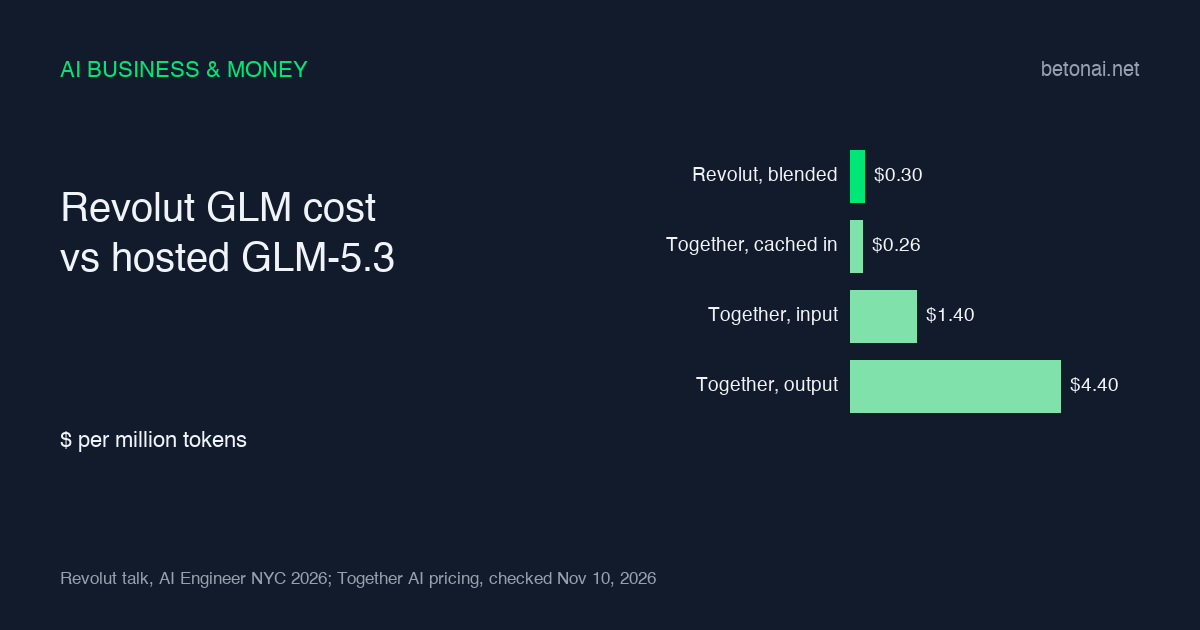
TL;DR: Revolut made a self-hosted open-weight model, Z.ai’s GLM (now GLM-5.3), the default AI coding model for roughly 2,000 engineers and kept Claude Code and Codex as “the exception.” Its AI operations lead says the blended cost is $0.30 per million tokens and the invoice is one-tenth of what it paid Anthropic and OpenAI. That number is real but narrow: it compares bills, not total cost, and it rests on 56 Nvidia B200 GPUs kept busy by a 2,000-engineer workforce. For most teams under a few hundred developers, the cheaper move is an open-weight model on a hosted API, not a GPU fleet.
What Revolut actually changed
The story broke wider after The Register’s November 3 report, but the source is a 15-minute talk by David Abitbol, who leads AI operations at Revolut, at AI Engineer New York. The conference has published a transcript, and the key lines are on the record there.
The sequence, as described in the talk and reported by The Register and AgentsPulse’s write-up of the slides:
- Early 2025: Revolut rolled out Gemini to staff.
- Early 2026: Claude Code launched at scale, with strict budget limits. Abitbol told the audience: “We were seeing engineers spend $1,000 a month, $10,000 a month with not so much ROI” (quoted by The Register).
- April 2026: Revolut began self-hosting open models, starting with GLM-5.1, according to AgentsPulse’s reading of the slides.
- Now: GLM-5.3 is the default coding model, served on 56 Nvidia B200 GPUs. Claude Code, Codex and Gemini stay in use as exceptions.
The important word is default. Revolut did not cancel its frontier tools. It flipped which model gets most of the token volume. In Abitbol’s words, as quoted by The Register: “Open source is now a priority at Revolut… The billing is flat, we don’t have any bill shock at the end of the month, and the frontier is the exception.”
The numbers, and what each one really measures
| Figure | Value | Source and caveat |
|---|---|---|
| Blended token cost | $0.30 per million | Talk transcript. The Register ties the $0.30 figure to GLM-5.1; input and output priced the same. |
| Bill vs. commercial tools | About one-tenth (~90% lower) | Talk transcript. Compares invoices; no matched usage periods were shown. |
| Engineers covered | About 2,000 | Talk: “a sample of 2,000 engineers.” |
| Hardware | 56 Nvidia B200 GPUs | The Register: equal in GPU count to seven 8-GPU DGX B200 systems. Ownership not disclosed. |
| Coding time / lead time | 60% / 70% improvement | Spoken figures. AgentsPulse notes the slide labels lead time as 60%; trends are observational. |
| Latency target | Under 3 s to first token, ~200 tokens/s | The Register. About 800 tokens/s after 5 p.m. when load drops. |
Two of these numbers are the same claim stated twice. “90% cheaper” and “one-tenth of the bill” are one data point, not two confirmations. And the productivity gains cannot be pinned on GLM alone: they are trends across 18 months in which Revolut changed several tools and processes.
Seats vs. self-hosting: why the comparison is lopsided
Per-seat and per-token tools price the same work in completely different ways. That is the real lesson from Revolut, more than the 10x headline.
What per-seat and per-token tools cost today
On Anthropic’s consumer pricing page (checked November 10, 2026), Claude Pro is $20 a month billed monthly ($17 a month on annual billing), Max is $100 and Ultra is $200. All three come with usage limits. Usage-billed access, the way Revolut ran Claude Code with budgets, has no ceiling except the one you set. That is how individual engineers reached the $1,000 to $10,000 a month Abitbol described.
As a scale illustration only (our arithmetic, consumer list prices, not what Revolut paid): putting 2,000 engineers on Max would cost $200,000 a month, and on Ultra $400,000 a month. Enterprise contracts are negotiated and will differ. The point is the shape of the bill: seats scale with headcount and usage-billed API spend scales with tokens. A self-hosted fleet costs roughly the same whether engineers send one prompt or one million.
Why “unlimited tokens” changed behaviour
Abitbol’s most interesting claim is not about price. He says the biggest gains came when engineers stopped rationing. “You no longer have to save your tokens for the end of the quarter or the most difficult task,” he said in the talk. Cheap tokens went into debugging, Jira and Confluence work, the jobs nobody would burn a capped budget on. Flat-rate capacity encourages that kind of use, while a metered bill discourages it.
What it takes to get to $0.30 per million
The $0.30 figure is an engineering outcome, not a sticker price. Here is what sits under it, per the sources.
A very large model
The Register puts GLM-5.1 at roughly 754 billion total parameters with 40 billion active per token, needing about 380 GB of GPU memory just to hold the weights, plus 6 to 26 GB per user for context depending on precision. This is not a model you run on a workstation.
Tuning beat buying more GPUs
According to the slides described by AgentsPulse, time to first token fell from 14.26 seconds mid-migration to 1.68 seconds on the same 56 GPUs, while request volume rose 76%. Abitbol credited most of that to serving parameters: NVFP4 quantisation, disaggregated prefill and decode, and context-length limits. His line on context, quoted by The Register: “Long context is a scam… Even though you can serve one million tokens, 256 [thousand] is really what you need.”
A router for what GLM can’t do
GLM runs text-only in Revolut’s setup, so a router sends image work to Gemini or OpenAI models, per The Register. Engineers kept their existing harnesses. AgentsPulse reports the endpoints are OpenAI-compatible and work inside Claude Code, Codex and OpenCode.
“Self-hosted” may mean dedicated, not owned
AgentsPulse notes the slide says the fleet runs “with Together,” a GPU and inference provider. The talk does not say whether Revolut owns or rents the B200s. That matters a lot for the cost math, because a rented dedicated fleet is an operating expense with a contract, not a capital purchase.
The cheaper middle path most teams should price first
You do not need 56 GPUs to use the same model. Together’s serverless price list (checked November 10, 2026) shows GLM-5.3 at $1.40 per million input tokens, $0.26 cached, and $4.40 per million output tokens. GLM-5.3-Flash is $0.15 in and $0.50 out.
| Option | How you pay | Best fit (our judgement) |
|---|---|---|
| Per-seat plans (Claude Pro/Max/Ultra and similar) | Flat per person, with usage limits | Small teams, predictable budgets, frontier quality needed |
| Frontier APIs, usage-billed | Per token, no ceiling | Hard tasks, agents where quality failures are expensive |
| Open-weight model on a hosted API (e.g. GLM-5.3 on Together) | Per token, low rates | Teams that want cheap bulk tokens without running GPUs |
| Dedicated or self-hosted fleet (Revolut’s route) | Fixed capacity cost | Large orgs with steady, high utilisation and data-residency needs |
Our arithmetic: Revolut’s $0.30 blended rate is about a fifth of Together’s serverless GLM-5.3 input price and well under a tenth of its output price. That gap is what dedicated capacity buys you, but only when the GPUs stay busy. Revolut has 2,000 engineers across time zones. That works out to about 36 engineers per GPU (our division), and a 30-person startup cannot recreate that load.
The costs a $0.30 headline leaves out
- People. Someone tuned quantisation, parallelism, cache hit rates and context windows for months. The talk does not price that time.
- Capacity risk. A fleet sized for peak sits partly idle at night. Revolut turns that into a perk (800 tokens/s after 5 p.m.), but idle capacity still costs money.
- Quality gap. Abitbol did not present a head-to-head quality benchmark against Claude or GPT models. Revolut’s case rests on cost and on giving engineers unlimited tokens.
- Compliance work. Abitbol addressed the concern about a Chinese-developed model directly: Revolut runs the downloaded weights on infrastructure it chooses, with no traffic to endpoints in China, per The Register and AgentsPulse. A regulated firm still has to document that setup for its risk teams.
- Hardware price. One commenter in the public discussion estimated 56 B200s at $2.5 million to $3 million to buy outright (cited by AgentsPulse). Treat that as a rough third-party estimate, not a Revolut figure.
What we don’t know yet
- Whether Revolut owns, leases or rents the GPUs as a managed dedicated service.
- The absolute size of the bill before and after, and whether the periods compared had similar usage.
- Whether the $0.30 figure was measured on GLM-5.1 only or still holds on GLM-5.3. The Register attributes it to 5.1.
- How much engineering headcount runs the platform.
- How often engineers escalate to the frontier “exception” tools, and what those still cost.
BetOnAI Verdict
Revolut’s move is a real data point, and it shows the coding market splitting into two tiers. Cheap, flat-rate open-weight tokens handle the bulk work, and frontier models are kept for the hard cases. The 10x is a bill comparison at very high utilisation, not a law of nature. If you run fewer than a few hundred developers, copy the architecture (default to a cheap open model, route hard tasks and vision to frontier models, stop rationing everyday tokens) and buy the cheap tokens from a hosted provider. Price GPUs only once your monthly API bill is large and steady enough that dedicated capacity would actually stay busy. For how the per-seat tools compare, see our agentic coding stack cost breakdown. For the small-scale version of the own-hardware question, see when an M5 Mac pays for itself.
Frequently Asked Questions
Did Revolut stop using Claude Code?
No. Revolut made self-hosted GLM the default coding model and kept Claude Code, Codex and Gemini as exceptions, according to David Abitbol’s AI Engineer New York talk and The Register’s report.
How much does Revolut pay per million tokens?
Abitbol said the blended cost of self-hosted GLM is 30 cents per million tokens, with input and output priced the same. The Register ties that figure to GLM-5.1, the model Revolut first deployed.
How many GPUs does it take to serve GLM-5.3 to 2,000 engineers?
Revolut uses 56 Nvidia B200 GPUs, which The Register notes is equal in GPU count to seven eight-GPU DGX B200 systems. The talk did not say whether the GPUs are owned or rented.
Should a small team self-host a coding model?
Usually not yet. A hosted open-weight API such as GLM-5.3 on Together ($1.40 in, $4.40 out per million tokens as of November 10, 2026) gets most of the price benefit without GPU, tuning and staffing costs. Self-hosting starts to make sense only at high, steady utilisation.
Sources
- The Register, November 3, 2026: https://www.theregister.com/ai-and-ml/2026/11/03/british-fintech-revolut-slashes-ai-coding-costs-10x-by-cutting-out-claude-and-going-self-hosted/5307345
- AI Engineer New York 2026, Revolut talk transcript: https://ai.engineer/nyc/2026/talks/revolut
- AgentsPulse, GLM for coding at Revolut: https://agentspulse.github.io/tutorials/glm-for-coding/
- Shattered, what the Revolut reports do and do not confirm: https://shattered.io/revolut-self-hosted-glm-ai-coding-costs-10x-2026/
- Together AI pricing (checked November 10, 2026): https://www.together.ai/pricing
- Claude pricing (checked November 10, 2026): https://claude.com/pricing

Written by Nik Sai
BetOnAI Editorial covers AI tools, business strategies, and technology trends. We test and review AI products hands-on, providing real revenue data and honest assessments. Follow us on X @BetOnAI_net for daily AI insights.
How we score: read the methodology

BetOnAI Editorial covers AI tools, business strategies, and technology trends. We test and review AI products hands-on, providing real revenue data and honest assessments. Follow us on X @BetOnAI_net for daily AI insights.
More from Nik Sai