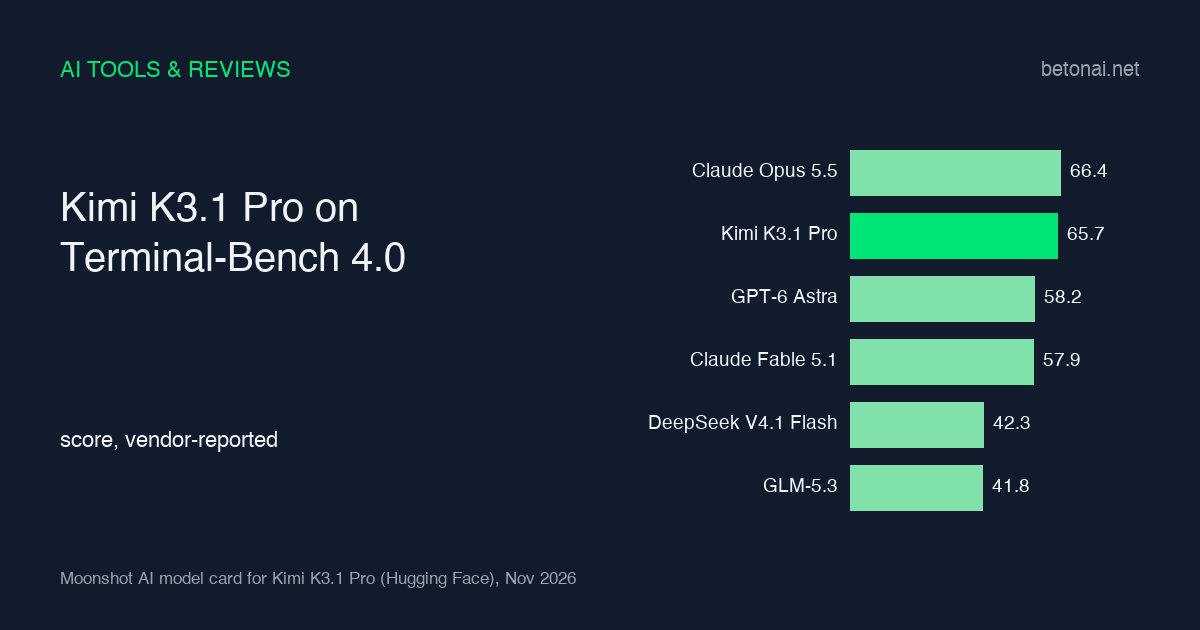
TL;DR: Moonshot AI’s Kimi K3.1 Pro is now an open-weight download: a 2.8-trillion-parameter mixture-of-experts model with 104 billion active parameters, a 1M-token context and image input. On Moonshot’s own benchmark table it scores 65.7 on Terminal-Bench 4.0, ahead of GPT-6 Astra (58.2) and just behind Claude Opus 5.5 (66.4). It trails badly on some harder tests. Hosted access lists at about $2 per million input tokens and $10 per million output. The weights take about 1.56 TB, so most teams will rent it rather than run it. Best fit: high-volume agentic coding and document-heavy finance work where frontier prices hurt.
What Moonshot released, and when
Moonshot announced Kimi K3.1 Pro on October 23, 2026 in its K3.1 Pro tech blog, calling it “our most capable 3T-class open-weight model to date.” The model went live that day on Kimi.ai, Kimi Work, Kimi Code and the Kimi API, alongside a K3.1 Pro Highspeed variant that Moonshot says runs 2 to 3 times faster. The blog promised full weights “by Nov 4.” They are now public on Hugging Face under moonshotai/Kimi-K3.1-Pro.
K3.1 Pro is not a new pretrain. Moonshot describes it as a post-trained version of Kimi K3 “with substantially larger post-training compute,” using large-scale reinforcement learning across hundreds of task domains.
Kimi K3.1 Pro quick facts
| Spec | Kimi K3.1 Pro (per model card) |
|---|---|
| Architecture | Mixture-of-Experts, 93 layers |
| Total / active parameters | 2.8T / 104B |
| Experts | 896 routed, 16 selected per token, 2 shared |
| Context window | 1,048,576 tokens |
| Inputs | Text and images (MoonViT-V2 encoder, 401M parameters) |
| Precision | MXFP4 weights, MXFP8 activations, quantisation-aware training |
| Repository size | About 1.56 TB (as reported by Shattered from the Hugging Face listing) |
| Recommended engines | vLLM, SGLang, TokenSpeed |
| License | Kimi K3.1-Pro License (permissive, with large-company conditions, see below) |
One architecture change matters for long documents. The card says Moonshot replaced K3’s full-attention Gated MLA layers with Gated DeepSeek Sparse Attention layers “for more efficient long-context modeling.”
The benchmarks, read carefully
Every number below comes from Moonshot’s own model card. Moonshot ran K3.1 Pro at maximum reasoning effort, mostly inside the Claude Code harness, and took many competitor scores from other companies’ reports or public leaderboards. The proprietary rows are marked “w/ fallback.” Treat this as the vendor’s claim until independent leaderboards catch up.
| Benchmark (vendor-reported) | Kimi K3.1 Pro | Claude Opus 5.5 | GPT-6 Astra | GLM-5.3 |
|---|---|---|---|---|
| Terminal-Bench 4.0 | 65.7 | 66.4 | 58.2 | 41.8 |
| SWE Marathon v1.1 | 51.7 | 46.3 | 42.5 | 42.5 |
| DeepSWE v1.1 | 75.5 | 74.2 | 74.1 | 66.9 |
| ProgramBench | 31.5 | 65.0 | 50.0 | 19.0 |
| Terminal-Bench-Science 0.1 | 38.1 | 63.3 | 68.1 | 8.1 |
| HLE-Full (no tools) | 51.1 | 59.8 | 53.6 | 43.0 |
| BrowseComp | 92.1 | 90.8 | 91.5 | — |
| OfficeQA Pro v2 | 64.4 | 62.2 | 54.4 | 31.1 |
The pattern matters more than any single row. K3.1 Pro is at or near the top on agentic, tool-using, multi-step work: terminal tasks, long software “marathons,” browsing and document question-answering. It falls well behind on ProgramBench, where Moonshot counts a task as solved only if it scores at least 95%. It also trails on science-heavy terminal tasks and no-tools reasoning. Put simply, it is a strong worker inside a good harness and a weaker solo thinker on the hardest problems.
The factual-accuracy claim
Moonshot says it targeted hallucinations for finance work. On its internal Kimi Hallu Bench Hard, the claim-level hallucination rate fell from 23.4% for K3 to 8.3%. Moonshot itself cautions that the benchmark is a deliberate stress test and the rates “do not represent overall error rates in daily use.” It is an internal benchmark, so it cannot be checked independently.
A deliberately weakened cyber skill set
Moonshot removed cyber-related data from mid-training and filtered cyber RL environments for the open release. On its internal xdev-bench-hard exploit benchmark, the unfiltered checkpoint solved 90.5% and the released model 81.0%. On the card’s ExploitGym row, K3.1 Pro scores 20.7 against GPT-6 Astra’s 42.4. For defenders who wanted an open exploit-development model, this is not it, and that is by design.
What it costs to use
Hosted pricing is where most readers will meet this model. OpenRouter’s listing (checked November 10, 2026) shows Moonshot’s own endpoint and providers including Together, Fireworks, DeepInfra and Nebius mostly at $2 per million input tokens and $9 to $10 per million output, with a few outliers above and below. Together’s price list shows $2.00 input, $0.20 cached input and $10.00 output.
| Open-weight model on Together (Nov 10, 2026) | Input / 1M | Output / 1M |
|---|---|---|
| Kimi K3.1 Pro | $2.00 | $10.00 |
| Kimi K3 | $3.00 | $15.00 |
| GLM-5.3 | $1.40 | $4.40 |
| DeepSeek V4.1 Flash | $0.30 | $1.20 |
Two practical notes. First, K3.1 Pro is cheaper than its own predecessor on Together and is the premium option among open models, at about 2.3 times GLM-5.3’s output price. Second, the model card says reasoning effort defaults to “max.” Max effort produces more reasoning tokens, and those are billed as output. If cost matters, test the “low” and “high” settings before you assume the $10 rate tells the full story. For how cheaper open models stack up on price, see our DeepSeek value check.
Self-hosting reality check
A roughly 1.56 TB download is the low-precision release. Our arithmetic: that is about four times the ~380 GB of weights The Register cited for GLM-5.1, before any memory for a 1M-token context. Running K3.1 Pro yourself means a large multi-GPU deployment. Unless you need full data control, hosted access will be cheaper and simpler.
The license, in plain terms
The Kimi K3.1-Pro License is MIT-style permission (use, modify, fine-tune, sell) with three conditions worth knowing:
- If you run a “Model as a Service” business (third parties get meaningful control over inference or fine-tuning, for example through an API) and you and your affiliates exceed $20 million in revenue over any 12 months, you need a separate agreement with Moonshot before commercial use.
- Products with more than 100 million monthly active users or more than $20 million in monthly revenue must prominently display “Kimi K3.1-Pro” in the interface.
- Neither condition applies to purely internal use, or to access through Moonshot’s own products or certified inference partners.
For nearly every startup, agency or internal tool, those conditions will never trigger.
Who should care, and who can skip it
- Care: teams running agentic coding in Claude Code-style harnesses at volume, where a model that is competitive on Terminal-Bench and SWE Marathon at $10 output could cut costs. Test it on your own repo first.
- Care: finance and document-heavy workflows that use long context and image input (scanned PDFs, charts). OfficeQA Pro v2 and the hallucination work target exactly this.
- Care: 3D, CAD and game prototyping. Moonshot reports 92.7 on BenchCAD with tools.
- Skip for now: hard from-scratch program synthesis and science reasoning, where the card itself shows a wide gap to Opus 5.5 and GPT-6 Astra.
- Check first: EU data-residency needs. OpenRouter notes the model is not currently available through its EU in-region routing.
What we don’t know yet
- Independent results. Nearly every comparison is Moonshot’s own, run in harnesses Moonshot chose, against competitor numbers taken from other reports.
- Real-world output-token use at “max” effort, which decides the true bill.
- How the Highspeed variant is priced and served across third-party providers.
- Serving cost and throughput on common GPU setups. No independent benchmark of self-hosted K3.1 Pro had been published when we checked.
BetOnAI Verdict
Kimi K3.1 Pro is the strongest case yet that an open-weight model can do frontier-grade agentic coding, on the vendor’s own numbers. It is not a frontier model across the board. ProgramBench and science reasoning show the gap. The useful move is to route to it, not switch to it. Send it your high-volume harness work and document analysis at roughly $2 / $10 per million tokens, and keep Opus- or Astra-class models for the hardest tasks. Measure cost per completed task, not cost per token, because max-effort reasoning can eat the price advantage. For what the closed flagships cost, see our Fable 5.1 vs GPT-6 Astra breakdown.
Frequently Asked Questions
Is Kimi K3.1 Pro really open source?
It is open-weight. The weights are downloadable from Hugging Face under the Kimi K3.1-Pro License, which allows commercial use and modification but adds conditions for very large companies and for model-as-a-service businesses over $20 million in revenue.
How does Kimi K3.1 Pro compare with Claude Opus 5.5?
On Moonshot’s own table it nearly ties Opus 5.5 on Terminal-Bench 4.0 (65.7 vs 66.4) and beats it on SWE Marathon (51.7 vs 46.3). It trails sharply on ProgramBench (31.5 vs 65.0) and HLE without tools (51.1 vs 59.8). These are vendor-reported figures.
How much does Kimi K3.1 Pro cost?
Most hosted providers on OpenRouter, including Moonshot and Together, list about $2 per million input tokens and $10 per million output tokens as of November 10, 2026. Reasoning effort defaults to max, which increases billed output tokens.
Can I run Kimi K3.1 Pro locally?
Not on consumer hardware. The low-precision weights are about 1.56 TB, so self-hosting needs a large multi-GPU server deployment using vLLM, SGLang or TokenSpeed.
Sources
- Moonshot AI, Kimi K3.1 Pro tech blog: https://www.kimi.ai/blog/kimi-k3-1-pro
- Hugging Face model card, moonshotai/Kimi-K3.1-Pro: https://huggingface.co/moonshotai/Kimi-K3.1-Pro
- Kimi K3.1-Pro License: https://huggingface.co/moonshotai/Kimi-K3.1-Pro/blob/main/LICENSE
- OpenRouter model page (checked November 10, 2026): https://openrouter.ai/moonshotai/kimi-k3.1-pro
- Together AI pricing (checked November 10, 2026): https://www.together.ai/pricing
- Shattered, Kimi K3.1 Pro open weights: https://shattered.io/moonshot-kimi-k3-1-pro-open-weights-2-8-trillion-parameters-2026/
- The Register (GLM-5.1 memory footprint), November 3, 2026: https://www.theregister.com/ai-and-ml/2026/11/03/british-fintech-revolut-slashes-ai-coding-costs-10x-by-cutting-out-claude-and-going-self-hosted/5307345

Written by Nik Sai
BetOnAI Editorial covers AI tools, business strategies, and technology trends. We test and review AI products hands-on, providing real revenue data and honest assessments. Follow us on X @BetOnAI_net for daily AI insights.
How we score: read the methodology

BetOnAI Editorial covers AI tools, business strategies, and technology trends. We test and review AI products hands-on, providing real revenue data and honest assessments. Follow us on X @BetOnAI_net for daily AI insights.
More from Nik Sai