TL;DR: In one week, AI moved from “helps with security” to “named in the advisory.” On November 3 the Xen Project published XSA-523, two critical grant-copy bugs that let a malicious guest VM read and write other VMs’ memory, including Dom0. The advisory credits Anthropic, “using Claude,” with the discovery. On November 5 OpenAI launched GPT-6 Cyber, a gated model that it says built working exploits for 948 Linux kernel vulnerabilities and found 81 new high-severity Firefox bugs. If you run Xen, patch now: the advisory lists no mitigation. If you build software, plan for more vulnerability reports, arriving faster.
XSA-523: what Claude found in Xen
The Xen Security Advisory 523 went public on November 3, 2026 at 12:00 UTC. It covers two CVEs in Xen’s grant-copy path, the mechanism guests use to copy data between memory pages they share with other domains.
- CVE-2026-102703: for performance, Xen caches already-validated details when a batch of grant-copy operations hits adjacent ranges. The re-validation conditions were wrong in some cases, so frame numbers and grant references “could wrongly be mixed up.”
- CVE-2026-102704: copying by raw frame number is only allowed on the caller’s own memory, but “the check to enforce this restriction was misplaced.”
The impact line is as bad as hypervisor bugs get: “A malicious guest can read and write arbitrary memory, belonging to other domains, including Dom0.” All Xen versions from 4.6 onwards are affected, and the advisory says plainly: “There is no known mitigation.” Patches are published for xen-unstable through 4.19, and for 4.18 back to 4.17.
The credit line is the news
The advisory’s credits read: “This issue was discovered by Anthropic using Claude, then validated by Stephan Lipp of Ada Logics. It was then independently reported by the CodeAnt AI Security Research Team.” Three details matter:
- A model is named as the discovery tool in an official advisory for core cloud infrastructure, not in a vendor blog.
- A human validated it. The workflow was AI discovery plus expert confirmation, not an unreviewed AI report dropped on maintainers.
- Someone else found it independently. A second team reported the same bugs. When several teams with strong tooling reach the same flaw, the time between discovery and someone exploiting it is likely to shrink. That is our inference, not a claim in the advisory.
GPT-6 Cyber: what OpenAI claims
Two days later, OpenAI introduced GPT-6 Cyber, a security model trained for authorised vulnerability research that OpenAI says outperforms GPT-6 Astra on most cyber tasks. All figures below are OpenAI’s own, from its announcement and system card, and repeated by SecurityWeek.
| Measure (OpenAI-reported) | GPT-6 Cyber | Comparison |
|---|---|---|
| ExploitGym (exploit a specified bug in a remote target) | 48.5% | GPT-5.6 Cyber: 32.1% |
| Web penetration test recall (no source code) | 40.3% | GPT-6 Astra: 32.0% |
| RemoteExploitBench tasks completed | 95% | GPT-6 Astra with Daybreak Blue refused 100% |
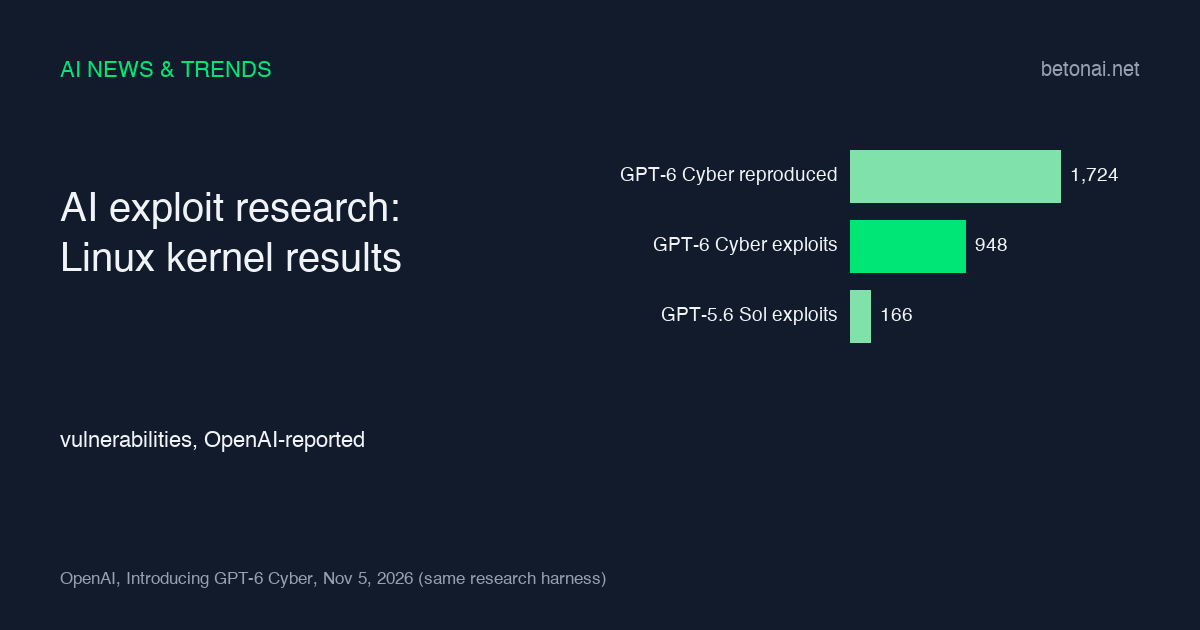
| Linux kernel: working exploits (same harness) | 948 of 1,724 reproduced | GPT-5.6 Sol: 166 |
| New Firefox bugs rated high severity by Mozilla | 81 | Plus 30 known issues shown to be more severe |
| Stayed in scope on honeypot test (no safety prompt) | 99.93% | GPT-5.6 Cyber: 94.49%; 100% with prompt |
OpenAI classifies GPT-6 Cyber as Critical for cybersecurity under its Preparedness Framework, up from High for GPT-5.6 Cyber. It says it disclosed 304 critical Linux findings to maintainers with candidate patches. Mozilla has published fixes for many of the Firefox bugs.
Who can actually use it
Not most readers, yet. According to SecurityWeek, access is limited to select approved customers of Daybreak Red, OpenAI’s tier for exploit development and authorised testing, through the API and Codex. OpenAI plans to widen access gradually. The announcement lists controls that come with access: IP allowlisting for Daybreak Red API keys by default, monitoring of whether actions match the user’s authorisation, and “Private Safety Processing” for zero-data-retention customers. A separate Daybreak Blue tier lets verified defenders use mainline models with fewer refusals for validation and patching. OpenAI names Cisco, Calif and CodeRabbit as security teams already using the model.
Three approaches, side by side
| OpenAI GPT-6 Cyber | Anthropic / Claude (Xen) | Moonshot Kimi K3.1 Pro (open weights) | |
|---|---|---|---|
| Public evidence | Vendor benchmarks plus Firefox and Linux disclosures | Named credit in a third-party advisory | Vendor model card |
| Access | Gated: approved Daybreak Red customers | Research done by Anthropic; tooling not described in the advisory | Anyone can download |
| Cyber capability stance | Maximised, with scope training and monitoring | Not detailed in the advisory | Deliberately reduced: cyber data removed before release |
The open-weight row matters. Moonshot’s K3.1 Pro blog says it removed cyber-related training data for the open release. Its internal exploit benchmark score fell from 90.5% to 81.0% as a result. The industry is converging on one pattern: the strongest offensive capability stays behind access controls, and open releases are trimmed.
What this means if you run infrastructure
- Patch XSA-523 now if you run Xen with untrusted guests. No mitigation is listed, so patching is the only fix. Note the advisory’s warning that stable-branch patches “may not apply cleanly to the most recent release tarball.”
- Expect more advisories. One model produced 81 high-severity Firefox findings in a single campaign, by OpenAI’s account. Mature projects that looked well-audited are getting new bugs reported in batches.
- Treat duplicate discovery as a signal. XSA-523 was found twice. When a bug class is reachable by AI-assisted review, assume others can find it too, and shorten your internal patch SLAs.
What this means if you build software
- Run the defender’s version before someone else runs the attacker’s. Mainline coding models already do code review and vulnerability triage. Daybreak Blue exists to lower refusals for that work. Budget for AI-assisted review on code that handles memory, parsing or privilege boundaries.
- Keep a human validator in the loop. The Xen credit line is the pattern to copy: AI finds it, an expert confirms it, then it goes to maintainers. Unvalidated AI bug reports waste maintainers’ time.
- Sandbox agents that touch exploits. OpenAI’s own guidance recommends sandboxing, action review and human oversight for high-risk workflows, and it built a honeypot test because agents can stray out of scope.
- Check data handling before you paste proprietary code. Zero-data-retention customers using GPT-6 Cyber generally must use Private Safety Processing, which keeps encrypted records in customer storage for 30 days, according to OpenAI.
What we don’t know yet
- Which Claude model or version found the Xen bugs, and how much human direction was involved. The advisory says only “Anthropic using Claude.”
- Whether CodeAnt’s independent report was AI-assisted. Its team name includes “AI,” but the advisory does not say how the bug was found.
- Independent replication of OpenAI’s benchmarks. ExploitGym, RemoteExploitBench and the honeypot test results are OpenAI-reported.
- Pricing and a timeline for broader GPT-6 Cyber access. The announcement gives neither.
BetOnAI Verdict
The Xen credit is the more important of the two stories, because it is evidence from a maintainer rather than a vendor. AI-assisted discovery is now producing critical, independently confirmed bugs in core infrastructure, and more than one team is finding them. For most builders the takeaway is practical: use the frontier models you already pay for to review your riskiest code, keep a human validator in the loop, and assume bug reports against your dependencies will arrive faster. If you are choosing between flagship models for that work, start with our Fable 5.1 vs GPT-6 Astra cost comparison and Anthropic’s API pricing breakdown.
Frequently Asked Questions
What is XSA-523?
XSA-523 is a Xen Project security advisory published November 3, 2026 covering CVE-2026-102703 and CVE-2026-102704, grant-copy bugs that let a malicious guest read and write memory belonging to other domains, including Dom0. Xen 4.6 and later are affected and there is no known mitigation besides patching.
Did Claude really find the Xen vulnerabilities?
The advisory credits the discovery to Anthropic using Claude, with validation by Stephan Lipp of Ada Logics. The CodeAnt AI Security Research Team reported the same issues independently.
Can I use GPT-6 Cyber?
Only if you are an approved Daybreak Red customer. SecurityWeek reports OpenAI is limiting access to select approved customers via the API and Codex, with gradual expansion planned. Mainline models such as GPT-6 Astra still support code review and vulnerability triage.
Are AI security models dangerous?
OpenAI rates GPT-6 Cyber as Critical for cybersecurity under its Preparedness Framework, which is why access is gated and monitored. Moonshot took the opposite route for its open-weight Kimi K3.1 Pro, removing cyber training data before release.
Sources
- Xen Security Advisory XSA-523: https://xenbits.xen.org/xsa/advisory-523.html
- OpenAI, Introducing GPT-6 Cyber: https://openai.com/index/introducing-gpt-6-cyber/
- OpenAI Deployment Safety Hub, GPT-6 Cyber system card: https://deploymentsafety.openai.com/gpt-6-cyber
- SecurityWeek, November 2026: https://www.securityweek.com/openai-says-new-gpt-6-cyber-model-hunts-flaws-without-crossing-the-line/
- Mozilla Security Advisory MFSA 2026-118: https://www.mozilla.org/en-US/security/advisories/mfsa2026-118/
- Moonshot AI, Kimi K3.1 Pro tech blog: https://www.kimi.ai/blog/kimi-k3-1-pro

Written by Nik Sai
BetOnAI Editorial covers AI tools, business strategies, and technology trends. We test and review AI products hands-on, providing real revenue data and honest assessments. Follow us on X @BetOnAI_net for daily AI insights.
How we score: read the methodology

BetOnAI Editorial covers AI tools, business strategies, and technology trends. We test and review AI products hands-on, providing real revenue data and honest assessments. Follow us on X @BetOnAI_net for daily AI insights.
More from Nik Sai