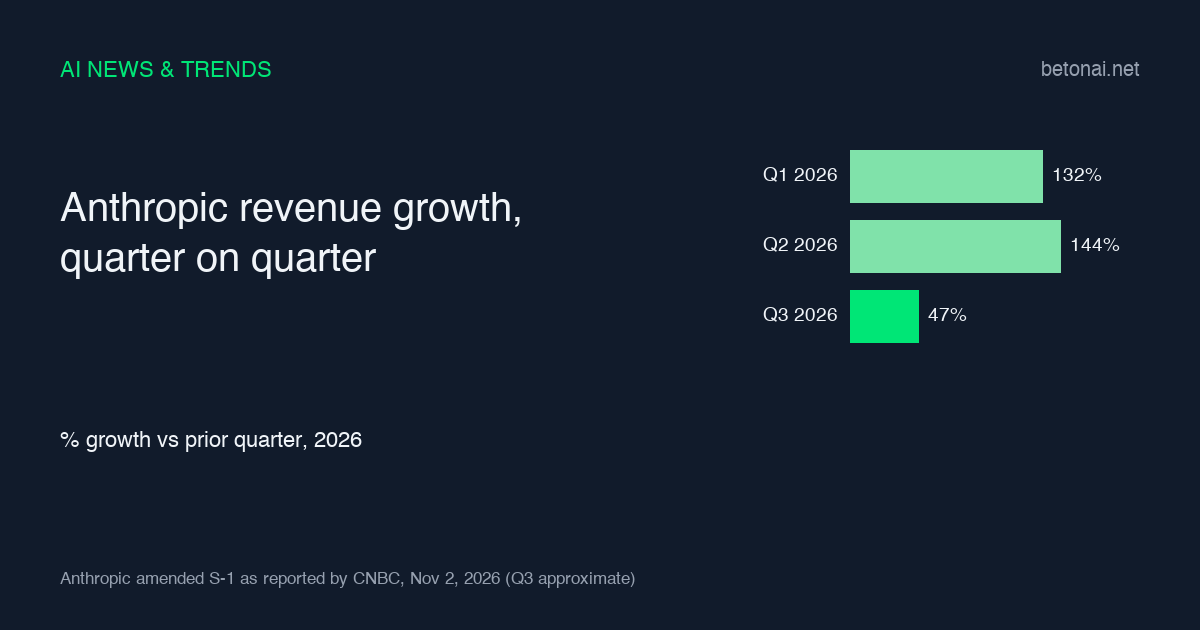
TL;DR: Anthropic’s IPO prospectus, filed October 26 and amended November 2, is the most detailed public look yet at the company behind Claude. For people who use and build on Claude, five disclosures matter. Revenue was $33.24 billion in the first nine months of 2026, but quarter-on-quarter growth slowed to about 47% in Q3. Anthropic says it has underestimated its compute needs before, which affected product plans. Nearly half of first-half revenue came through AWS, Google Cloud and Azure. The filing names cheaper and open-source models as a risk to demand. And Anthropic has committed about $895 billion, mostly to compute. Practical takeaway: plan for capacity limits, keep a fallback model, and expect price competition from open weights to continue.
The filing in one paragraph
Anthropic, PBC announced its S-1 registration statement for a proposed IPO of Class A common stock, to list on the Nasdaq Global Select Market under the ticker “ANT.” The share count and price range “have not yet been determined.” Goldman Sachs and Morgan Stanley lead the underwriting. According to CNBC’s coverage of the filing, Anthropic filed confidentially in June and publicly on October 26. An amended S-1 on November 2 added third-quarter results. Figures below are from the filing as reported by CNBC unless noted.
The numbers that matter
| Disclosure | Figure |
|---|---|
| Revenue, first half of 2026 | $16.29B (vs $1.16B a year earlier) |
| Revenue, nine months to Sept 30 | $33.24B, up roughly 1,200% |
| Q3 2026 revenue | About $17B |
| Quarter-on-quarter revenue growth | Q1 132%, Q2 144%, Q3 about 47% |
| Implied gross margin, H1 2026 | 85% (cost of revenue $2.38B), vs 12% a year earlier |
| Net loss, nine months | $104B, mostly fair-value changes on convertible notes and derivatives |
| Net revenue retention (Sept 30) | About 900% |
| Revenue via AWS, Google Cloud, Azure (H1) | 48% |
| International revenue (H1) | $4.5B, 27.8% of total |
| Aggregate purchase and lease commitments | About $895.4B, “substantially all” compute and infrastructure |
A note on the losses. The headline net losses ($80.7 billion for the first half, $104 billion for nine months) are dominated by accounting changes in the value of convertible notes and derivatives, per CNBC. They are not a measure of how much it costs to serve your API calls. The 85% implied gross margin is closer to that.
Five things in the S-1 that matter to Claude users and builders
1. Compute is the constraint, and Anthropic says it has misjudged it before
The filing warns that Anthropic’s plans depend on access to “enormous and increasing quantities of specialized compute,” and that compute forecasts are “inherently uncertain.” According to CNBC, Anthropic disclosed that it “has underestimated its compute requirements in the past, which impacted its product development and deployment plans.”
For users, that is the clearest official explanation so far for the rate limits, waitlists and staged rollouts that Claude customers have hit. The fix Anthropic is buying is scale: roughly $417 billion in compute obligations starting in 2026–2027, another $125–150 billion ordered for 2028–2031, a non-cancellable commitment of at least $110 billion with Amazon through April 2036, and $114.5 billion on Google TPUs through 2033, per CNBC. More capacity is coming. The filing does not promise that limits will disappear.
What to do: if Claude sits in a production path, keep a tested fallback model and degrade gracefully when you hit limits. Do not design around unlimited throughput.
2. Nearly half of Claude revenue flows through the big clouds
Anthropic said 48% of first-half revenue came through AWS, Google Cloud and Microsoft Azure, which “bill end customers, collect payments on our behalf, and remit such amounts to us, net of applicable platform and other fees.” Sales and marketing costs rose 2,540% to $3.17 billion, of which $2.7 billion was fees paid to channel partners.
What it means: buying Claude through Bedrock, Vertex AI or Azure is a core channel, not a side door. If your company already has cloud commitments, using that route is normal and may simplify procurement. The filing also lists the flip side as a risk: any change to a major distribution relationship “could adversely affect our business by disrupting customer access to our models.”
3. Anthropic names cheaper and open models as a risk
Among more than 90 pages of risk factors, CNBC highlights a scenario builders should notice: customers may decide that “incremental performance gains at the frontier do not justify the additional cost” and switch to cheaper or open-source alternatives. That is not hypothetical. Fintech Revolut reported cutting its AI coding bill to about a tenth by making a self-hosted open-weight model its default and keeping Claude Code as an exception.
What it means: the company itself expects buyers to weigh frontier quality against price. Route by task. Use Claude where the quality difference pays for itself, and test cheaper models for bulk work.
4. Margins are high now, but Anthropic says they will swing
The implied 85% gross margin in the first half is far above the 12% of a year earlier. The S-1 also says operating margins are expected to “fluctuate over time, particularly in periods when substantial incremental compute is delivered.” Compute and infrastructure expenses rose by $14.4 billion in the nine months, up 329%, per the amended filing.
What it means (our read): high margins give Anthropic room to compete on price, but the filing does not promise cuts, and big compute deliveries will weigh on profitability. Watch list prices on the Claude pricing page (Pro $20 monthly, Max $100, Ultra $200 as of November 10, 2026) rather than assuming they will fall.
5. Customers are expanding fast, and international capacity is growing
Net revenue retention of about 900% means existing customers increased spending about ninefold year on year. CNBC cites a median of 108% for public cloud software companies. Anthropic attributes this to customers starting with one use case and expanding across departments, and to new models lowering the cost of specific tasks. International revenue reached $4.5 billion in the first half, and the filing says Anthropic has leased data center capacity in Australia and Canada and is pursuing more outside the US.
What it means: if your Claude bill is climbing quickly, you are typical, not an outlier. Set spend controls early. The international data center leases may eventually mean more regional hosting options, but the filing does not announce new data-residency products.
Chips: a multi-vendor bet
The filing says Anthropic runs on Nvidia GPUs, AMD GPUs, AWS Trainium and Google TPUs, treated as a “single fungible pool,” with technology that routes its models to whichever chip is most efficient at the time. It may also buy more than $20 billion of AMD chips, per CNBC. For users, the practical effect is resilience. Claude capacity is not tied to a single chip supplier’s shortages.
What we don’t know yet
- The IPO price range, share count and listing date. The press release says these are not yet determined.
- Revenue by product: how much comes from Claude Code, the API and consumer plans. CNBC’s reporting does not break this out.
- Whether the Q3 slowdown to about 47% sequential growth reflects capacity limits, pricing or demand. The filing excerpts we reviewed do not say.
- Any change to model pricing or usage limits. Nothing in the coverage points to planned price moves.
We read the filing through CNBC’s reporting and Anthropic’s own announcement. Readers who need precision on specific line items should check the amended S-1 on SEC EDGAR directly.
BetOnAI Verdict
For Claude users, the S-1 reads less like an investment pitch and more like an operations manual. Capacity is the bottleneck, the clouds are a main sales channel, and Anthropic openly expects some buyers to move bulk work to cheaper models. None of that should make you switch away from Claude. It should make you build a little defensively: a fallback model, spend alerts, and task routing that saves frontier tokens for frontier problems. For the per-token detail, see our Anthropic API pricing guide. For the wider IPO race, see our earlier look at the OpenAI and Anthropic filings.
Frequently Asked Questions
When did Anthropic file its S-1?
Anthropic filed publicly on October 26, 2026, after a confidential filing in June, and filed an amended S-1 with third-quarter results on November 2, according to CNBC. It plans to list on Nasdaq under the ticker ANT.
How much revenue does Anthropic make?
The amended filing reports $33.24 billion in revenue for the nine months to September 30, 2026, including roughly $17 billion in the third quarter, per CNBC.
Will the IPO change Claude’s pricing or rate limits?
Nothing in the filing coverage announces pricing changes. The S-1 does say compute capacity is a key constraint and that Anthropic has underestimated its needs before, so usage limits are likely to remain a factor while new capacity comes online.
Does the S-1 mention open-source competition?
Yes. Its risk factors include customers deciding that frontier performance gains do not justify the extra cost and choosing cheaper or open-source alternatives, as reported by CNBC.
Sources
- Anthropic, S-1 announcement: https://www.anthropic.com/news/s1-sec
- CNBC, Anthropic IPO live updates, October 26, 2026: https://www.cnbc.com/2026/10/26/anthropic-ipo-live-updates-ai-s-1-filing.html
- CNBC, amended S-1 and Q3 financials, November 2, 2026: https://www.cnbc.com/2026/11/02/anthropic-ant-s-1-quarter-financials.html
- CNBC, risk factors in the S-1, October 27, 2026: https://www.cnbc.com/2026/10/27/anthropic-five-surprising-risks-s1.html
- SEC EDGAR, Anthropic S-1/A: https://www.sec.gov/Archives/edgar/data/2130357/000162828026068676/anthropicpbc-sx1ax1.htm
- The Register, Revolut self-hosting, November 3, 2026: https://www.theregister.com/ai-and-ml/2026/11/03/british-fintech-revolut-slashes-ai-coding-costs-10x-by-cutting-out-claude-and-going-self-hosted/5307345
- Claude pricing (checked November 10, 2026): https://claude.com/pricing

Written by Nik Sai
BetOnAI Editorial covers AI tools, business strategies, and technology trends. We test and review AI products hands-on, providing real revenue data and honest assessments. Follow us on X @BetOnAI_net for daily AI insights.
How we score: read the methodology

BetOnAI Editorial covers AI tools, business strategies, and technology trends. We test and review AI products hands-on, providing real revenue data and honest assessments. Follow us on X @BetOnAI_net for daily AI insights.
More from Nik Sai