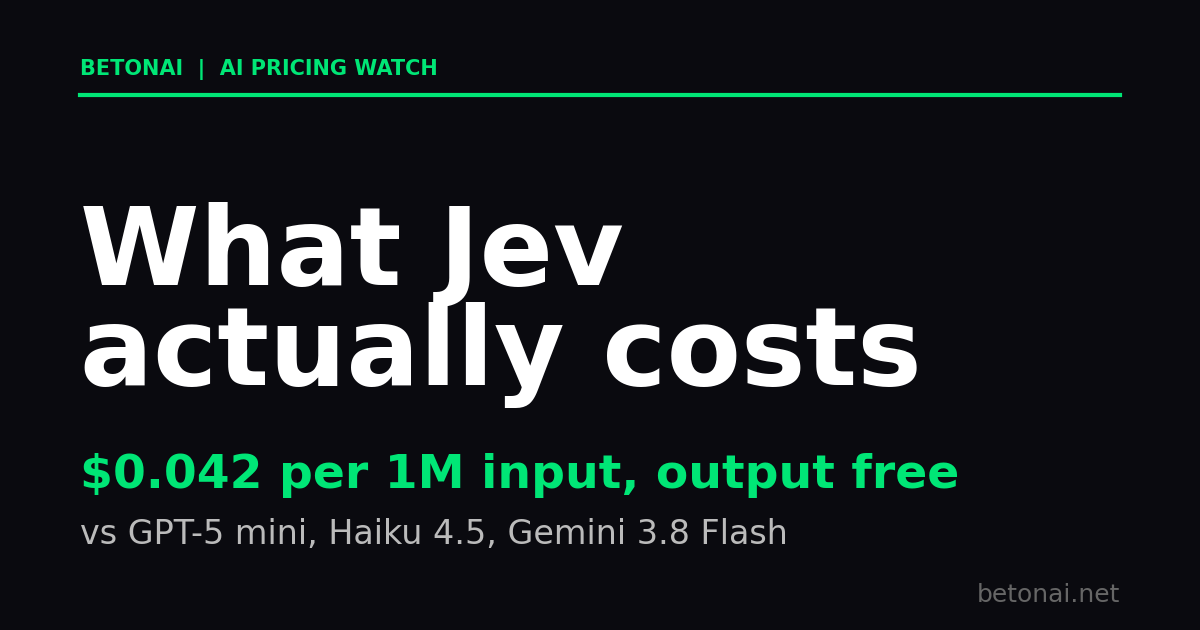
Jev is a decision model from TypeSafe AI: you send it a block of state plus typed questions and it returns answers with probabilities, never text. It launched on September 15, 2026 as the first of what TypeSafe calls System One models, and it is priced at $0.042 per million input tokens with output free, which makes it the cheapest paid model on OpenRouter for anything shaped like a classification.
TL;DR: Jev 1.13 costs $0.042 in / $0 out per 1M tokens, direct or on OpenRouter, checked September 19, 2026. On a 600-in, 60-out classification call that is an estimated $25.20 per million decisions, versus $270 on GPT-5 mini, $675 on Gemini 3.8 Flash and $900 on Claude Haiku 4.5. Only gpt-oss-20b, at $25.80, is in the same bracket. The catch: Jev cannot write a word, has a 32K context, answers three question types, and direct access is a waitlist. It is not an LLM replacement. It is a cheaper if-statement.
Jev Pricing at a Glance (September 19, 2026)
Prices per 1M tokens, input / output. Comparator prices are from OpenRouter’s model listing; Jev’s price is from TypeSafe’s launch post and matches OpenRouter’s Jev 1.13 page.
| Model | Input | Output | Context | Returns |
|---|---|---|---|---|
| TypeSafe Jev 1.13 | $0.042 | $0 | 32K | Typed decisions with probabilities |
| OpenAI gpt-oss-20b | $0.03 | $0.13 | 131K | Text |
| OpenAI GPT-5 mini | $0.25 | $2.00 | 400K | Text |
| Google Gemini 3.8 Flash | $0.75 | $3.75 | 1M | Text |
| Anthropic Claude Haiku 4.5 | $1 | $5 | 200K | Text |
No output price at all, which TypeSafe calls “too cheap to meter,” and an input rate below every frontier-vendor small model. Only gpt-oss-20b, an open-weight model on third-party hosts, is cheaper on input. Through OpenRouter card credits the 5.5% top-up fee makes it an estimated $0.044 per 1M; fee mechanics are in our OpenRouter pricing guide.
Who Built It and Why the Price Is This Low
TypeSafe AI left stealth on September 15 with a $40 million seed led by DCVC. Founder Diogo Almeida worked at OpenAI on the instruction-following and RLHF research behind ChatGPT. His pitch: chat models are the wrong tool for the decisions software makes millions of times a day.
The price follows from the architecture. An LLM emits one token at a time and bills each one. Jev evaluates every question in a request in parallel and returns probabilities, so there is nothing to meter on output. It is trained with what TypeSafe calls Reinforcement Learning for Calibrated Decisions (RLCD), optimising for honest probabilities rather than text a rater prefers. The launch post claims 70 to 500 ms latency and “40x-200x faster”; the homepage’s 193.6x faster and 444.6x cheaper figures come from TypeSafe’s own workflow evals. Vendor claims, all of them, and TypeSafe itself says the multiples “are on the higher end of real world gains.”
Cost per 1,000 and per 1 Million Decisions
Assume one classification call: 600 input tokens (a ticket or lead record plus a short question set) and 60 output tokens (an LLM’s JSON answer). Per-call cost is input tokens times input rate plus output tokens times output rate, per 1M. Estimates: real token counts vary, and LLMs need a longer prompt than Jev to force structured output.
| Model | Arithmetic per call | Per call | Per 1,000 decisions | Per 1M decisions |
|---|---|---|---|---|
| Jev 1.13 | 600 x $0.042/M + 60 x $0 | $0.0000252 | $0.025 | $25.20 |
| gpt-oss-20b | 600 x $0.03/M + 60 x $0.13/M | $0.0000258 | $0.026 | $25.80 |
| GPT-5 mini | 600 x $0.25/M + 60 x $2.00/M | $0.00027 | $0.27 | $270 |
| Gemini 3.8 Flash | 600 x $0.75/M + 60 x $3.75/M | $0.000675 | $0.68 | $675 |
| Claude Haiku 4.5 | 600 x $1/M + 60 x $5/M | $0.0009 | $0.90 | $900 |
On list price Jev is an estimated 10.7x cheaper than GPT-5 mini, 26.8x cheaper than Gemini 3.8 Flash and 35.7x cheaper than Haiku 4.5 for this call shape. Against gpt-oss-20b it is a wash: $25.20 versus $25.80. That is the honest headline. The “400x cheaper” figure only appears against frontier models nobody should be using for yes/no questions. Free output matters more as answers get longer; ask an LLM for five decisions with reasoning and its output bill grows while Jev’s stays at zero.
The per-decision money is small either way: at 1M decisions a month the Jev-to-Haiku spread is $875. What changes the business case is latency, no parsing layer, and a calibrated confidence number you can threshold on. For the wider small-model price war, see our AI API pricing war 2026 comparison.
Measured, not quoted. BetOnAI called Jev 1.13 through OpenRouter’s decisions endpoint from Southeast Asia on September 19, 2026, a long way from TypeSafe’s West Coast servers.
- End-to-end latency per call: 0.5 to 1.4 seconds.
- Input billed: 342 tokens. Output: free.
- Cost per call as reported by OpenRouter’s
usage.costfield: $0.0000144, which is exactly $0.042 per 1M input tokens.
That is above TypeSafe’s 70 to 500 ms claim, which it measures from the West Coast, and still a fraction of a reasoning-model round trip. BetOnAI has since run an independent benchmark of Jev against GPT-5 mini, Haiku 4.5 and Gemini 3.8 Flash on live crypto order flow: 320 windows, Brier, calibration, latency and measured cost per 1,000 decisions.
What Jev Cannot Do
Read this before you get excited.
- No text generation. Jev cannot write a reply, a summary, a query or a single word. If the job ends in prose, you still need an LLM.
- 32K context. OpenRouter lists a 32,000-token window. A long contract or full chat transcript will not fit. Chunk it or summarise first with something else.
- Three question types only. Per the TypeSafe docs: noul (a yes/no probability from 0 to 1), choice (one option from a list, with a probability per option and a confidence score), and score (a rating against ordered levels, with distribution and confidence). No free-form extraction, no entity lists.
- Text only, English first. The docs say images, audio and video are not supported yet, and other languages, including CJK scripts, currently have lower accuracy.
- It can still be wrong. TypeSafe says Jev “can’t hallucinate,” meaning the output always matches your schema. It can still pick the wrong option with 0.84 probability. The difference is you get to see the 0.84.
- Direct access is a waitlist. OpenRouter and Vercel AI Gateway work today without an invite.
How to Call Jev
Three routes, one request shape: a state (string, object or array), a model, and a map of named questions.
- Direct.
POST https://api.typesafe.ai/v1/systemonewith a bearer key and"model": "jev-latest". The quick start shows a three-question support-ticket call returning a department choice, a frustration score and an urgency noul from 312 input tokens. Python SDK:pip install typesafe-sdk. Waitlisted at the time of writing. - OpenRouter (beta).
POST https://openrouter.ai/api/alpha/decisionswith model idtypesafe/jev-1.13. The path is under/api/alpha, not/api/v1, and the normalchat/completionsendpoint rejects the model. OpenRouter’s API reference has the schema; its example bills 476 input tokens at $0.000019992, exactly $0.042 per 1M. Announced on OpenRouter’s X account September 18. - Vercel AI Gateway. Model id
typesafe-ai/jevthrough AI SDK 7’s experimentalevaluatefunction, per Vercel’s September 16 changelog. Vercel calls the yes/no type boolean. AI SDK only, not the OpenAI-compatible endpoint; zero data retention per request.
LangChain users get it as TypeSafeClassifier in langchain-typesafe, per LangChain’s September 17 post. State can be text, structured data or LangChain messages, so it drops into a middleware hook as is.
Where Jev Makes Money
Jev pays off wherever a chat model is currently running in a loop to produce a label, a route or a number. Six obvious switches:
- Lead scoring and routing. Form plus enrichment record as state; a score for fit, a choice for which rep or sequence. At $0.025 per 1,000 leads the model cost is invisible, and the confidence field lets you auto-route only the leads Jev is sure about. This is the kind of build priced in our AI automation rate card; the client never sees that your per-decision cost fell 30x. Your margin does.
- COD and RTO risk scoring for e-commerce. Refused cash-on-delivery orders are a margin killer wherever COD dominates. Order, address, history and cart as state; a noul “will this be refused at the door” plus a score for risk tier, at checkout, in under a second. Gate high-risk orders to prepaid.
- Ad comment moderation. Every comment on a paid post gets a choice across spam, complaint, buying intent and abuse. A million comments costs an estimated $25.
- LLM-as-judge and evals. OpenRouter’s own cascade cookbook uses Jev to check whether a cheap model’s answer is supported by retrieved context, escalating to a frontier model only on failure. OpenRouter reports zero wrong answers, same as running the frontier model on everything, at about 7% of the cost on its 50-question example.
- Model routing in agent harnesses. “Cheap model, frontier model or human for this step?” is a choice question. LangChain positioned Jev exactly here: the decision node in the loop, so the expensive model only runs when the decision says so.
- Search term mining. A week of search query reports as state in 32K chunks; noul “is this query commercial intent,” choice for product category. Negative-keyword lists fall out for pennies.
The pattern: the decision already exists in your stack as a brittle rule, a human, or an overpriced LLM call.
BetOnAI Verdict
Jev is real and the price is real. It is not an LLM. Price it as a component, not a platform.
- Should pay: anyone running more than roughly 100,000 classify, route, score or yes/no calls a month on GPT-5 mini, Haiku or Gemini Flash. The token saving is small; the latency drop and the confidence field change what you can automate. Agencies selling automation builds should move every scoring and routing node to Jev and keep the margin.
- Should pay, carefully: teams with an LLM-as-judge pipeline. Calibrated output beats a chat model asked to “rate 1 to 10.” Run both side by side for a month before cutting the LLM.
- Should not pay: anyone whose job ends in text. Anyone with inputs over 32K tokens. Anyone happy on gpt-oss-20b for classification, because the cost is identical and the switch buys calibration and speed, not savings. And anyone who needs a production SLA: the OpenRouter route is labelled alpha, direct is a waitlist, and the vendor is four days out of stealth.
The move: put $10 on OpenRouter, rewrite your ugliest routing prompt as a choice question, and compare Jev’s confidence distribution to your current model’s accuracy on a hundred labelled examples. Estimated cost: three cents. Track price moves on our AI Pricing Watch hub.
Frequently Asked Questions
Is Jev an LLM?
No. Jev is what TypeSafe calls a System One model: it evaluates typed questions against a state and returns a choice, a score or a yes/no probability with a confidence value. It does not generate tokens and cannot write text. Think of it as a function call that returns probabilities.
How much does Jev cost?
$0.042 per 1M input tokens and $0 for output, the same direct and on OpenRouter, checked September 19, 2026. A 600-token classification call is an estimated $0.0000252, or $25.20 per million calls. Through OpenRouter card credits the 5.5% fee brings it to roughly $0.044 per 1M.
Can Jev hallucinate?
Not in the schema sense: every answer is one of the options you defined, which TypeSafe calls type-safety. It can still choose the wrong option. The difference is that each answer carries a calibrated probability and a confidence score, so your code can send low-confidence answers to a human instead of acting on them.
Jev vs a fine-tuned classifier: which is cheaper?
A self-hosted fine-tuned classifier has near-zero marginal cost but needs labelled data, an engineer, and retraining whenever categories change. Jev needs none of that: you edit the question text. At $25 per million decisions the API cost is close to self-hosting anyway. Jev wins on time to ship; a custom classifier wins only at very high volume with stable categories and a team to maintain it.
Is Jev on OpenRouter?
Yes, in beta since September 18, 2026, as typesafe/jev-1.13 at $0.042 / $0, through a separate decisions endpoint at /api/alpha/decisions. Chat completions rejects it. The OpenRouter SDK needs its base URL set to https://openrouter.ai for this path. It is also on Vercel AI Gateway as typesafe-ai/jev.
How fast is Jev?
TypeSafe claims 70 to 500 ms end to end, measured from the US West Coast. BetOnAI measured 0.5 to 1.4 seconds per call through OpenRouter from Southeast Asia on September 19, 2026. Both are far below a reasoning model, which TypeSafe’s own comparison puts at 3 to 329 seconds. Extra questions in one call add almost no latency because they are evaluated in parallel.
Sources
- TypeSafe AI, Introducing System One Models & Jev (pricing, latency claims, RLCD): https://typesafe.ai/blog/introducing-system-one-models-and-jev
- TypeSafe docs, introduction and question types: https://docs.typesafe.ai/
- TypeSafe docs, quick start (direct endpoint, jev-latest, SDK): https://docs.typesafe.ai/introduction/quickstart
- TypeSafe docs, state (text only, language note): https://docs.typesafe.ai/concepts/state
- TypeSafe docs, confidence: https://docs.typesafe.ai/confidence
- OpenRouter, Jev 1.13 model page ($0.042 / $0, 32K context): https://openrouter.ai/typesafe/jev-1.13
- OpenRouter, Decisions API reference: https://openrouter.ai/docs/api/api-reference/alphadecisions/submit-a-decisions-questions-and-answers-request
- OpenRouter, Jev-verified cascade cookbook: https://openrouter.ai/docs/cookbook/evaluate-and-optimize/jev-verified-cascade
- OpenRouter, model listing JSON (comparator prices): https://openrouter.ai/api/v1/models
- OpenRouter on X, Jev beta announcement, September 18, 2026: https://x.com/OpenRouter/status/2100744709589316009
- Vercel changelog, Jev on AI Gateway, September 16, 2026: https://vercel.com/changelog/typesafe-ai-jev-now-available-on-ai-gateway
- LangChain, What Is Jev? Building a harness with Jev: https://www.langchain.com/blog/building-a-harness-with-jev
- Tech Startups, TypeSafe AI emerges from stealth with $40M: https://techstartups.com/2026/09/16/typesafe-ai-an-ai-startup-founded-by-chatgpt-co-inventor-emerges-from-stealth-with-40m-to-build-ai-thats-100x-faster-and-cheaper/
- DataCamp, Jev: TypeSafe’s System One Model Explained: https://www.datacamp.com/blog/system-one-models-jev
- ThursdAI, September 17, 2026 episode: https://sub.thursdai.news/p/typesafes-jev-changes-everything
- BetOnAI, OpenRouter pricing 2026: https://betonai.net/openrouter-pricing-2026-complete-guide-to-every-model-tier-and-hidden-cost/

Written by Nik Sai
BetOnAI Editorial covers AI tools, business strategies, and technology trends. We test and review AI products hands-on, providing real revenue data and honest assessments. Follow us on X @BetOnAI_net for daily AI insights.
How we score: read the methodology

BetOnAI Editorial covers AI tools, business strategies, and technology trends. We test and review AI products hands-on, providing real revenue data and honest assessments. Follow us on X @BetOnAI_net for daily AI insights.
More from Nik Sai