TL;DR: Rokid Glasses are $599 today on Rokid’s own store, down from a $699 compare-at price. GPT-6 Astra lists at $10 in / $50 out per million tokens. Wire the two together and a realistic solo-operator setup costs about $39 a month in API spend, or roughly $68 a month once you amortise the hardware over two years. The surprise is where the money goes. The overnight job, the one that turns a day of conversations into finished work while you sleep, costs $4.40 a month because batch processing is half price. Answering you out loud in the moment costs four times more. The frontier model is not the expensive part of this stack. Listening and replying are.
The pitch, stated plainly
You wear a 49 gram pair of glasses. They hear what you hear. An idea arrives in a taxi and you say it out loud instead of losing it. A meeting ends and the follow-ups are already drafted. You walk past a price on a shelf and a line of green text tells you whether it is a good number. You get home and the work is done, because the agents ran while you were on the road rather than while you sat at a screen at midnight.
That is the promise, and most of it is buildable today. Not all of it. The gap between the two is what this piece is about, and the gap is not where people usually assume it is. It is not cost. It is battery, wake words and screen real estate.
It is also the logical endpoint of a shift that has been building all year. Assistants stopped waiting to be asked and started doing work in the background, a change we covered when Google put a price on an always-running agent and again when Apple rebuilt Siri on somebody else’s model. Glasses are simply the first form factor where an always-running agent has ears and eyes.
What you are actually buying
Two devices matter here. Prices and specifications below were read from Rokid’s global store on September 5, 2026.
| Item | Price | What it gives you |
|---|---|---|
| Rokid Glasses (with display) | $599 (from $699) | 49 g, dual monochrome green Micro-LED waveguide, 12MP camera, four microphones, two speakers |
| Charging case | $99 | Effectively mandatory, see the battery section |
| Clip-on sunglasses | $39 | Optional |
| Rokid AI Glasses Style | $349 | 38.5 g, camera and audio only, no display |
Under the hood the display pair runs a Snapdragon AR1 Gen 1 for the application side plus a low-power NXP chip for wake-word listening, with 2GB of memory, 32GB of storage, Wi-Fi 6, Bluetooth 5.3 and a 210 mAh battery. Each eye gets a 480 by 398 monochrome green panel at up to 1500 nits. The camera is a fixed-focus 12MP Sony IMX681 with a 109 degree field of view. Rokid’s product page cites a 30 degree display field of view while launch coverage cited roughly 23 degrees, so treat that number as approximate.
Read those specs again with a business hat on. Two gigabytes of memory and a mid-tier mobile chip mean the glasses are a very good microphone, camera and teleprompter. They are not where the thinking happens. The thinking happens in the cloud, which is exactly why the model bill is the number that decides whether this is a toy or a tool.
The part nobody prices correctly
Here is the model side, read from the OpenAI pricing page on September 5, 2026. Every figure is per million tokens unless marked otherwise.
| Component | Rate |
|---|---|
| GPT-6 Astra, standard | $10 in, $1 cached in, $50 out |
| GPT-6 Astra, batch or flex | $5 in, $25 out |
| GPT-6 Astra, long context | $20 in, $75 out |
| GPT-5.6 Luna, standard | $0.20 in, $1.20 out |
| Async transcription | $0.0045 per minute |
| Live transcription | $0.017 per minute |
| Live translation | $0.034 per minute |
| Realtime voice, mini tier | $10 in, $20 out on audio tokens |
| Text to speech | $15 per million characters |
Those are the headline rates. The wider vendor-by-vendor picture, including the tiers below Astra, sits in the full OpenAI rate breakdown and the three-way vendor comparison.
Now put a working month through it. Assume 22 working days, two hours a day of captured conversation, twenty questions a day asked out loud, and one overnight job that reads the whole day and produces a plan. Speech runs at roughly 130 words a minute, so two hours is about 15,600 words, call it 21,000 tokens, plus a few thousand tokens of context and instructions.
| Job | How it is billed | Per month | Share |
|---|---|---|---|
| Listening, 2,640 minutes | Async transcription | $11.88 | 31% |
| Answering out loud, 440 questions | Astra standard | $19.80 | 51% |
| Thinking overnight, 22 runs | Astra batch | $4.40 | 11% |
| Speaking, 176,000 characters | Text to speech | $2.64 | 7% |
| Total API | $38.72 | ||
| Hardware over 24 months | $698 amortised | $29.08 | |
| All in | $67.80 |
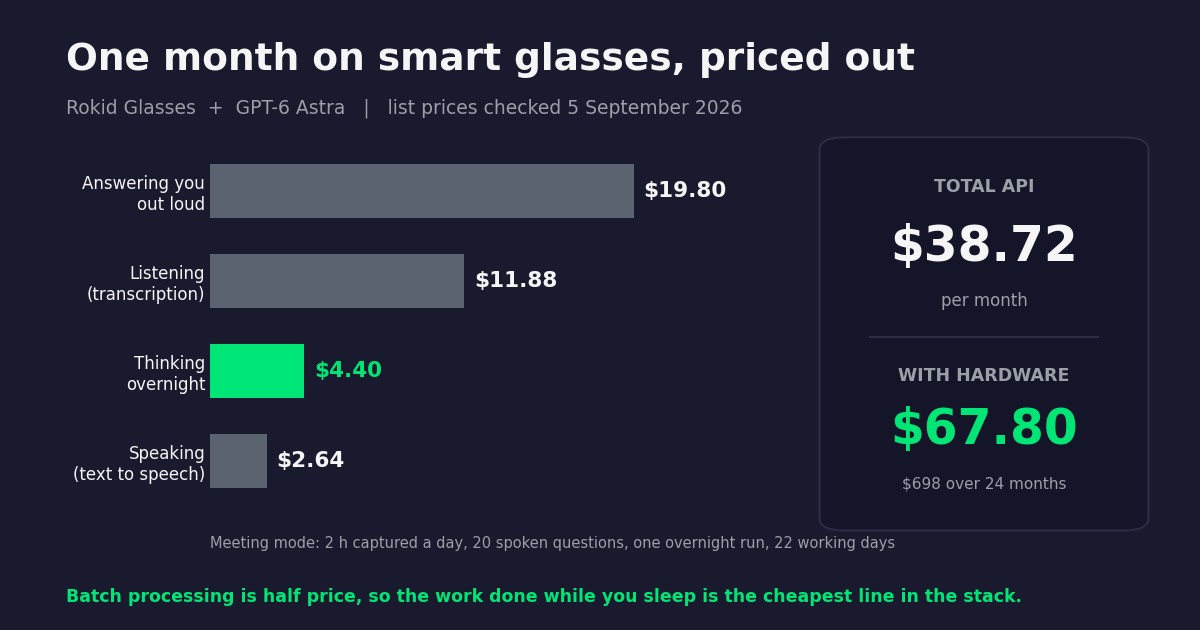
The line that should change how you build this is the third one. The overnight job, the one that reads every conversation you had, drafts the follow-ups, updates the plan and queues tomorrow, costs $4.40 a month. Answering you in the moment costs $19.80. Deep work done while you sleep is the cheapest thing in the stack, and it is cheap for a boring structural reason: batch and flex processing are billed at half the standard rate. The pricing model literally pays you to let things wait until morning.
That inverts the usual advice. People assume the frontier model is the luxury and the plumbing is free. It is the other way around. If you want to cut this bill, do not downgrade the overnight brain. Downgrade the thing that answers trivia. Route the twenty daily questions to a cheap model and only escalate the hard ones, and the $19.80 line drops to about $0.44, taking the whole API bill to roughly $19 a month. The routing logic is the same pattern covered in our OpenRouter pricing guide and in the cheapest AI stack breakdown.
Four ways to run it
| Setup | What changes | API | All in |
|---|---|---|---|
| Lean | Cheap model handles live questions | $19 | $48 |
| Meeting mode | Two hours a day captured, Astra answers | $39 | $68 |
| Always on | Eight hours a day captured, 40 questions | $100 | $129 |
| Always on with live captions | Real-time transcription all day | $232 | $261 |
Even the heaviest configuration lands under $300 a month. For context on what that buys on the other side of the ledger, operators running this class of automation for clients charge between $1,500 and $10,000 a month, as covered in the automation retainer breakdown and the retainer playbook. The arbitrage is not subtle, and it is the same margin structure behind white-label API reselling and the revenue models in the solo operator earnings breakdown.
The four jobs it does well today
1. Nothing gets lost
The highest-value feature is the least impressive one. An idea spoken into the glasses in a taxi is captured, transcribed for less than a cent, and picked up by the overnight run. No app, no unlock, no typing. Most productivity systems fail at capture, not at organisation, and this fixes capture by removing every step between having the thought and recording it.
2. The meeting post-mortem
Feed the day’s transcripts to Astra overnight and ask for three things: what was committed to and by whom, what was left ambiguous, and where you talked past someone. The third one is the reason to pay for a frontier model rather than a summariser. Cheap models produce minutes. Expensive models notice that a client said “let us revisit budget” twice and you moved on both times.
Note the price gap between analysing a conversation after the fact and holding one live. Per-minute voice agent economics, which is what you pay when a model talks to someone in real time, run an order of magnitude above transcription, as the numbers in the voice agent cost comparison show. Listening is cheap. Conversing is not.
3. The deal check
Photograph a price, have it read, compare against live sources, get a verdict in a short line of green text. This works, with two caveats. The camera is fixed focus, so shelf labels are fine and small print at an angle is not. The display gives you one or two lines, not a comparison table, so the model must be prompted to answer in under a dozen words. “Below average, similar unit listed at $340” is the right output. A paragraph is a failure.
4. Portfolio watching, not portfolio trading
Read-only monitoring with spoken alerts is a good use. Letting an agent execute trades on your behalf is not, and no part of this stack changes that. Keep the money-moving step human, keep the agent on alerting, and treat any tool that offers otherwise with suspicion. The same discipline applies to anything with irreversible consequences, which is the theme running through our comparison of agent frameworks.
How you actually wire a different model in
This is where Rokid separates itself from the obvious alternatives. Meta’s glasses ship with Meta’s assistant and you do not get to replace it. Rokid publishes a developer surface with four parallel routes: a phone companion SDK, on-glasses native applications, an open-source JavaScript runtime for on-glasses apps, and a cloud agent path that explicitly supports bringing your own model. There is a documented AI model access route, an open platform with an agent studio, and a first-party agent store.
One important limit: the assistant is open at the model layer, but the wake word is reserved. You will be saying “Hi Rokid” and routing what follows to your own model. You will not be saying “Hey Astra”. For a personal setup that is cosmetic. For a product you intend to brand, it matters.
The practical architecture that falls out of the pricing:
- On the glasses: wake word, capture, display. Nothing clever.
- On the phone: buffering, queueing, and the decision about which model a request deserves.
- In the cloud, immediately: short questions to a cheap model, escalating only when the cheap model flags uncertainty.
- In the cloud, overnight: everything else, on the batch tier, at half price.
That fourth bucket is the one that makes the whole thing feel magical, and it is the cheapest. It is also the bucket that most closely matches how agentic coding tools already work: queue the work, sleep, review the output in the morning.
The people file, and the law
The most requested feature in this category is also the most legally loaded: a searchable record of everyone you have met and what was said. Build it carelessly and it is a liability rather than an asset.
The rules, in brief. United States federal wiretap law works on one-party consent, meaning that if you are part of the conversation you are generally permitted to record it. Roughly eleven states require all-party consent, and in those states everyone in the conversation must agree. State law is stricter than federal law where it applies. In the European Union, recorded images of identifiable people are personal data under the GDPR, which brings its own obligations. There is no single statute governing smart glasses anywhere; courts are applying older recording and wiretapping rules to a device those rules never anticipated.
The version that survives contact with a lawyer looks like this:
- Capture only conversations you are a participant in, never ambient audio of strangers.
- Say that you are recording. On these glasses that is one sentence at the start of a meeting.
- Store your own summary, not raw audio, and delete the audio on a fixed schedule.
- Keep the file to professional facts. What was agreed, what was promised, when to follow up.
- Set a retention window and enforce it automatically.
Handled that way it is a CRM you never have to type into. Handled the other way it is a surveillance device with your name on it. For anyone working with regulated clients, the local-processing options in the privacy-first operator guide and the local AI cost comparison are worth reading before any of this touches a client conversation.
Three things that will actually stop you
Battery. The glasses carry 210 mAh. Reviewers report up to eight hours of mixed use and around six hours streaming music, and continuous capture with the camera and radios active drains far faster than that. The $99 charging case is not an accessory, it is part of the purchase. Plan for capture in bursts around meetings rather than an unbroken eight-hour day, which is also the configuration the cost table rewards.
The display. Monochrome green, 480 by 398 per eye, in a field of view of roughly 23 to 30 degrees. This is a device for a line of text, a direction arrow or a subtitle. Every prompt in your system needs a hard output limit, and anything longer has to be spoken rather than shown.
Availability. GPT-6 Astra was announced on September 3, 2026 and API access has been rolling out to accounts since. The published price is real; universal access is not yet. Until your account has it, the same architecture runs on the previous generation with no design changes, and the model comparison in our Astra versus Fable 5.1 cost breakdown covers the alternatives at the same tier.
A thirty-day build order
- Week one, capture only. Glasses to phone to transcription to a dated text file. No intelligence at all. If capture is not reliable, nothing built on top of it will be. Budget under $12 a month.
- Week two, the overnight run. One scheduled batch job that reads the day and returns commitments, follow-ups and a plan for tomorrow. This is the $4.40 line, and it is where the value appears.
- Week three, live answers. Wake word to cheap model, with escalation to the frontier model only when confidence is low. Enforce a twelve-word answer limit for anything shown on the lens.
- Week four, the people file. Structured notes, explicit consent, automatic retention limits. Do this last, once the rest is stable.
Nothing in that sequence requires a team. It requires an evening a week and a willingness to leave work queued overnight instead of grinding through it at a screen, which is the actual behavioural change on offer here. The point is not that you work more hours. It is that the hours run without you.
The verdict
Can one person run a serious business with a pair of glasses and a frontier model? Not by itself, and anyone promising that is selling something. What is genuinely true is narrower and more useful: for well under $100 a month you can remove the two failure points that quietly cost solo operators the most, which are ideas that never got written down and meetings that never got followed up. The hardware is real, the prices are published, and the architecture is four boxes and a queue.
The thing worth internalising is the pricing asymmetry. Real-time intelligence is expensive and mostly unnecessary. Overnight intelligence is half price and does the work that matters. Build for the second one and the bill stays small, which is the same conclusion reached in the September pricing roundup and tracked continuously in the pricing hub.
Frequently Asked Questions
How much does it cost to run Rokid Glasses with GPT-6 Astra?
About $39 a month in API spend for a realistic setup covering two hours of captured conversation a day, twenty spoken questions a day and one overnight analysis run. Adding the $599 glasses and $99 charging case amortised over 24 months brings it to roughly $68 a month all in. Routing routine questions to a cheaper model cuts the API portion to around $19. Running capture for a full eight-hour day with live captions is the expensive extreme at roughly $261 a month.
Can you use GPT-6 Astra or another third-party model on Rokid Glasses?
Yes. Rokid publishes a developer surface that is open at the model layer, including a documented AI model access route, phone and glasses SDKs, an open-source on-glasses app runtime and a cloud agent path for bringing your own model. The wake word itself is reserved, so the trigger phrase stays “Hi Rokid” and your model handles everything after it. This is the main practical difference from Meta’s glasses, where the assistant is closed.
Is it legal to record conversations with smart glasses?
It depends on where you are. United States federal wiretap law operates on one-party consent, so recording a conversation you are part of is generally permitted, but roughly eleven states require consent from everyone present and the stricter state rule applies. In the European Union, recorded images of identifiable people count as personal data under the GDPR. No jurisdiction has a single law written specifically for smart glasses, so older recording and wiretapping rules apply. The safe pattern is to record only conversations you participate in, announce it, store summaries rather than raw audio, and delete on a schedule.
Sources
- Rokid, Rokid Glasses product page (checked September 5, 2026): https://global.rokid.com/products/rokid-glasses
- Rokid, Open Platform: https://open.rokid.com/
- Rokid, Terminal SDK documentation: https://x-docs.rokid.com/docs/en/terminal-sdk/glasses/
- OpenAI, API pricing (checked September 5, 2026): https://developers.openai.com/api/docs/pricing
- PCMag, Rokid Glasses review (battery figures): https://www.pcmag.com/reviews/rokid-glasses
- Engadget, hands-on with Rokid’s smartglasses: https://www.engadget.com/wearables/rokids-smartglasses-are-surprisingly-capable-153027590.html
- Atlantic Council, Smart glasses are the blind spot in US privacy law: https://www.atlanticcouncil.org/dispatches/smart-glasses-are-the-blind-spot-in-us-privacy-law/
- Built In, Smart glasses laws in the US: https://builtin.com/articles/are-smart-glasses-legal
- United States federal wiretap statute, 18 U.S.C. section 2511

Written by Nik Sai
BetOnAI Editorial covers AI tools, business strategies, and technology trends. We test and review AI products hands-on, providing real revenue data and honest assessments. Follow us on X @BetOnAI_net for daily AI insights.
How we score: read the methodology

BetOnAI Editorial covers AI tools, business strategies, and technology trends. We test and review AI products hands-on, providing real revenue data and honest assessments. Follow us on X @BetOnAI_net for daily AI insights.
More from Nik Sai