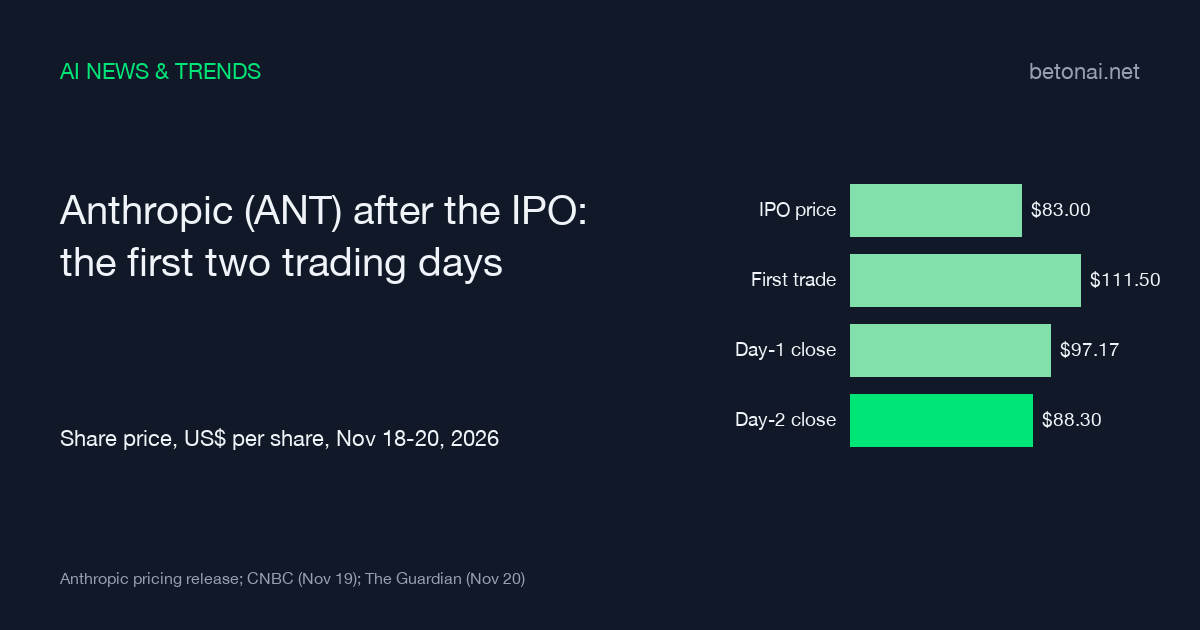
TL;DR: Anthropic priced its IPO at $83 a share on November 18, above its $70–78 range, and sold 980 million shares to raise about $81.3 billion, the largest IPO on record. ANT opened at $111.50 on November 19, closed its first day at $97.17 (up 17%), then fell about 9% to $88.30 on day two as a broad AI sell-off hit tech stocks. CNBC put the first-day value at roughly $1.8 trillion on a fully diluted basis. For Claude users and builders, the stock price matters less than what the final prospectus says: Anthropic expects to spend most of the new money on compute, it has changed usage and rate limits before and says it may again, and it lists open-weight models and price cuts as live risks. Nothing announced so far changes Claude’s plans or API prices.
What happened, in numbers
Anthropic announced that it priced its offering of Class A common stock at $83.00 per share. The deal was 980 million shares: 956,351,354 sold by Anthropic and 23,648,646 sold by existing stockholders. Underwriters also got a 30-day option to buy up to 147 million more shares. A week earlier the plan was smaller. According to CNBC’s IPO guide, Anthropic had marketed 825 million shares at $70 to $78 each.
| Item | Figure | Source |
|---|---|---|
| Marketed range | 825M shares at $70–78 | CNBC |
| Final IPO price | $83.00, 980M shares | Anthropic |
| Amount raised in IPO | About $81.3B | CNBC |
| First trade (Nov 19) | $111.50, up 34% | CNBC |
| Day-one high | $114.99 | Yahoo Finance |
| Day-one close | $97.17, up 17% | CNBC |
| Day-one volume | More than 846M shares | CNBC |
| Day-two close (Nov 20) | $88.30, down about 9% | The Guardian |
| Net proceeds to Anthropic (IPO plus private placement) | About $104.8B (about $117.0B if the option is fully exercised) | Final prospectus |
Two days is a short record, and Friday’s drop was not Anthropic-specific. The Guardian reports that the Nasdaq Composite erased its 2026 gains on November 20, Nvidia fell 14% and Micron fell 12%. Analysts quoted there pointed to doubts about AI spending and valuations rather than anything in Anthropic’s own numbers. At $88.30 the stock was still about 6% above the $83 offer price (BetOnAI calculation from the figures above).
Why the valuation figures don’t agree
You will see $1.3 trillion, $1.7 trillion, $1.8 trillion and “more than $2 trillion” in coverage. They are measuring different things.
- Fully diluted: CNBC said Anthropic closed day one with a fully diluted market cap of roughly $1.8 trillion, and topped $2 trillion near the open. Fully diluted counts options, unvested stock awards and convertible notes as if they were already shares.
- Shares outstanding only: the final prospectus lists about 13.22 billion shares across all classes outstanding after the offering and private placement. Multiplied by the $97.17 close, that is about $1.28 trillion. At the $88.30 day-two close it is about $1.17 trillion. These are BetOnAI calculations (shares outstanding × closing price), not reported figures.
- The Guardian reported roughly $1.7 trillion at the day-one close, without stating its share basis.
The practical point: headlines that compare Anthropic with Big Tech usually use the fully diluted number, which is the larger one.
Who owns it and who controls it
Per CNBC’s reading of the prospectus, Amazon owns 14.7% and Google 13.7% of outstanding capital stock after the offering. Nvidia agreed to buy about $10 billion of Class N stock in a private placement right after the IPO. Control sits with the founders: a single Class F share held by “Founder LLC,” whose members are the seven co-founders, carries 50.1% of the voting power. Anthropic remains a public benefit corporation, and its Long-Term Benefit Trust can elect and remove a majority of the board.
For customers, this means the company is not exposed to an activist takeover or a quick change of direction. The founders who set today’s product and safety policies still have voting control.
What the final prospectus says that matters to Claude users
We searched the final prospectus (424B4) for the passages that affect people who pay for Claude or build on its API. Five stand out. (For the earlier S-1 numbers, see our S-1 breakdown.)
1. The money is going into compute
The prospectus says net proceeds will go to general corporate purposes, “including investments in compute and infrastructure,” plus hiring and retaining staff. Anthropic also says that “in the past, we have significantly underestimated our compute requirements, which left us capacity constrained and impacted both product development and deployment.” CNBC reported that Dario Amodei defended about $900 billion in AI commitments after the bell, citing cash on hand and revenue.
What it means: more capacity should arrive, but it arrives on data-center timelines, not stock-market ones. The filing itself warns that compute delivery “may not align with the timing of demand growth.”
2. Usage and rate limits can change
The risk factors state: “We have also changed, and may in the future change, usage limits, rate limits, or model and product capabilities.” Anthropic adds that some of these changes have led to claims that its disclosures about model access were inadequate.
What it means: if Claude is in a production path, treat limits as variable. Keep a fallback model, handle 429 errors cleanly, and watch for plan-level changes on the pricing page.
3. Prices could fall, or change shape
The filing says Anthropic “may be required to reduce our prices, offer shorter contract durations, or offer alternative pricing models, such as outcome- or task-based pricing.” It also flags that agentic products are “structurally more compute-intensive,” and that it needs pricing that reflects that cost. Separately, it says Opus 5.5 cut customer cost per task by about 40% compared with Opus 5.
What it means (our read): two pressures point in different directions. Competition pushes per-task cost down. Heavy agent workloads push Anthropic toward pricing that charges more for them. Builders running long agent loops should expect the most change.
4. Open-weight models are a named risk
Anthropic writes that open-weight or open-source models “may capture a portion of the market for certain use cases, which could exert pricing pressure on our offerings.” It also describes a growing set of providers competing for workloads “that prioritize cost efficiency over intelligence.”
What it means: the company expects some buyers to move bulk work elsewhere. Routing simple tasks to cheaper models is now a normal practice, not a sign of disloyalty.
5. Old models will not disappear overnight
The prospectus says safety, interpretability and welfare considerations “may lead us to limit or delay the deprecation of older models.” It also acknowledges that forced deprecation could cause customer attrition.
What it means: good news for teams with pinned model versions. It is not a guarantee, so keep migration tests ready.
Current Claude plan prices (unchanged by the IPO)
As of November 21, 2026, the Claude pricing page lists:
| Plan | Price | Notable inclusions |
|---|---|---|
| Free | $0 | Limited usage every 5 hours and every week |
| Pro | $20/month, or $17/month billed annually | Claude Code, Projects, Fable via usage credits |
| Max | $100/month | 5x Pro usage, $100/month in API credits, priority at peak times |
| Ultra | $200/month | No 5-hour limit for verified accounts, 10x Pro weekly usage, $200/month API credits |
The page notes that “price and plans are subject to change at Anthropic’s discretion.” That line was there before the IPO too. For per-token API rates, see our Anthropic API pricing guide.
What builders should do this month
- Don’t change vendors because of the stock price. A falling share price does not change model quality, uptime or your contract. Anthropic just added roughly $105 billion in net proceeds, per the prospectus.
- Do budget for limit changes. The filing says limits have changed before and may again. Build retry logic and a second model into anything customer-facing.
- Watch agent pricing. The filing’s language on compute-heavy agentic workloads is the clearest hint of where pricing experiments may come.
- If you sell Claude-based services, put model cost pass-through clauses in client contracts. Our guide to AI automation retainers covers how to structure them.
What we don’t know yet
- Whether the underwriters will exercise their option for the extra 147 million shares. The prospectus gives proceeds both with and without it.
- How the stock trades once the broader tech sell-off settles. Two sessions in a falling market say little.
- Any change to Claude plan prices, API prices or limits. None has been announced since the listing.
- When analysts at the lead underwriters start coverage. Melius initiated with a $155 target on day one, per CNBC. That is one analyst’s view, not a forecast we endorse.
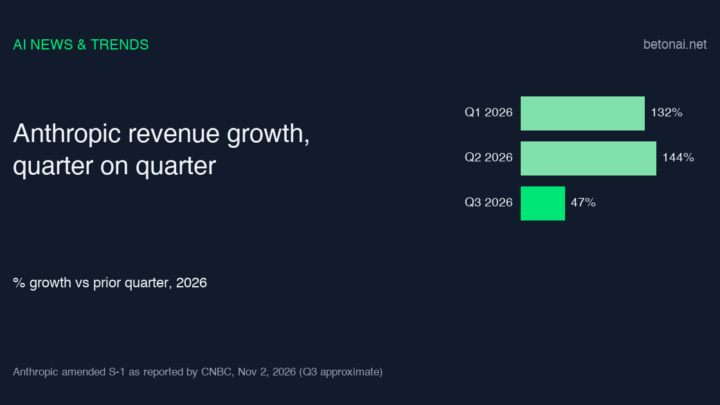
- Q4 2026 results. These will be the first quarterly report as a public company, and the first test of whether the Q3 growth slowdown continued.
BetOnAI Verdict
The IPO was a record, and the first two days were volatile: a 34% pop at the open, a 17% gain at the first close, then a 9% drop in a market-wide AI sell-off. None of that changes how Claude works for you today. What should change is how you plan. Anthropic has told public investors, in writing, that it has been short of compute before, that it may change limits, that it may change pricing models, and that cheaper open models are taking some work. Build with a fallback, track your spend per task, and keep an eye on agent pricing. The company now has about $105 billion in fresh capital to fix the capacity problem. Whether that shows up as looser limits will take quarters, not days, to see.
Frequently Asked Questions
What was Anthropic’s IPO price?
$83.00 per share for 980 million Class A shares, according to Anthropic’s pricing announcement. The marketed range had been $70 to $78.
How did ANT stock do in its first days?
It opened at $111.50 on November 19 and closed at $97.17, up 17%, per CNBC. On November 20 it fell about 9% to $88.30, per The Guardian, as AI stocks sold off broadly.
What is Anthropic worth?
CNBC reported about $1.8 trillion at the first close on a fully diluted basis. Using only shares outstanding listed in the prospectus, the value at the first close was about $1.28 trillion (BetOnAI calculation).
Will Claude get cheaper or more expensive after the IPO?
Nothing has been announced. The prospectus says Anthropic may need to reduce prices or try task-based pricing, and that agentic workloads are more compute-intensive. Current plan prices are unchanged.
Will rate limits improve?
Possibly over time. The proceeds are earmarked partly for compute, but the filing warns that new capacity may not line up with demand, and that limits may change again.
Sources
- Anthropic, “Anthropic prices initial public offering”: https://www.anthropic.com/news/anthropic-prices-initial-public-offering
- Anthropic final prospectus (424B4), SEC EDGAR: https://www.sec.gov/Archives/edgar/data/2130357/000162828026074944/anthropicpbc-424b4.htm
- CNBC, Anthropic IPO live updates, November 19, 2026: https://www.cnbc.com/2026/11/19/anthropic-ipo-ant-live-updates.html
- CNBC, Anthropic IPO guide (price range): https://www.cnbc.com/2026/11/16/anthropic-ipo-date-price-range.html
- CNBC, Morning Squawk, November 20, 2026: https://www.cnbc.com/2026/11/20/tech-wreck-drags-anthropic-into-the-red-on-its-second-day-of-trading.html
- The Guardian, second day of trading, November 20, 2026: https://www.theguardian.com/business/2026/nov/20/global-stock-markets-slump-anthropic-ipo-ai-sell-off
- The Guardian, key takeaways from the debut: https://www.theguardian.com/technology/2026/nov/20/anthropic-ipo-historic-stock-market-debut-key-takeaways-what-next-for-ai
- Yahoo Finance, Nasdaq debut (day-one high): https://finance.yahoo.com/markets/stocks/articles/anthropic-set-start-trading-completing-135519162.html
- Claude pricing (checked November 21, 2026): https://claude.com/pricing

Written by Nik Sai
BetOnAI Editorial covers AI tools, business strategies, and technology trends. We test and review AI products hands-on, providing real revenue data and honest assessments. Follow us on X @BetOnAI_net for daily AI insights.
How we score: read the methodology

BetOnAI Editorial covers AI tools, business strategies, and technology trends. We test and review AI products hands-on, providing real revenue data and honest assessments. Follow us on X @BetOnAI_net for daily AI insights.
More from Nik Sai