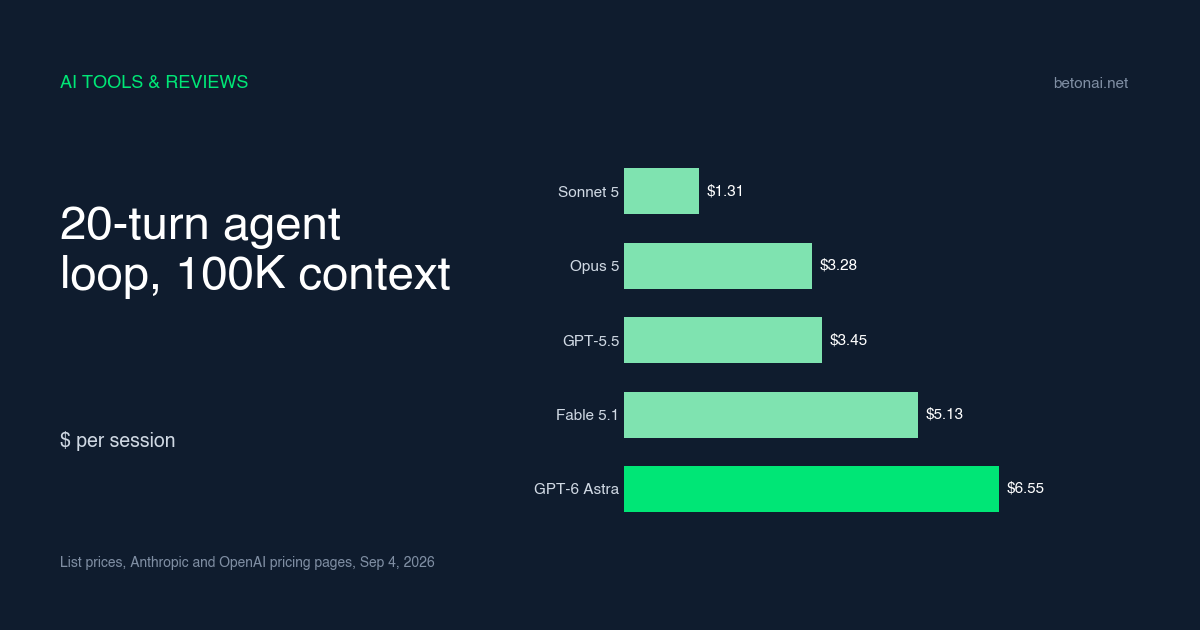
TL;DR: Claude Fable 5.1 (launched September 1, 2026) and GPT-6 Astra (announced September 3, 2026) both list at $10 in / $50 out per 1M tokens: $60 for a million each way. The sticker is a tie. The bill is not. Fable 5.1 charges $0.25 per 1M cached input tokens, Astra $1. On a one-shot prompt that changes nothing. On a 20-turn agent loop over 100K context Fable 5.1 is 22% cheaper ($5.13 vs $6.55). On a 200-turn coding session it is 32% cheaper ($62.50 vs $92.50). Opus 5 and GPT-5.5 do most of the same work for roughly half. Pay $60 only when your evals prove you need it.
Same sticker, different bill
The price card, per 1M tokens, checked September 4, 2026 on the Anthropic pricing page and the OpenAI pricing page.
| Model | Input | Output | Cache read | Cache write | Context | Max output |
|---|---|---|---|---|---|---|
| Claude Fable 5.1 | $10 | $50 | $0.25 | $12.50 (5 min) / $20 (1 hr) | 1M | 128K |
| GPT-6 Astra | $10 | $50 | $1.00 | $12.50 | 1.05M | 128K |
| Claude Opus 5 | $5 | $25 | $0.50 | $6.25 (5 min) / $10 (1 hr) | 1M | 128K |
| GPT-5.5 | $5 | $30 | $0.50 | none listed | 272K at standard rate | not listed |
| Claude Sonnet 5 | $2 | $10 | $0.20 | $2.50 (5 min) / $4 (1 hr) | 1M | 128K |
Two details matter more than the headline numbers.
First, the cache read column. Anthropic’s pricing page prices cache hits on Fable 5.1 at 0.025x base input, versus 0.1x on every other Claude model. That is the whole reason Fable 5.1 is a separate price point from Fable 5, which still charges $1 per 1M cached tokens at the same $10 / $50. OpenAI’s GPT-6 Astra model page lists cached input at $1, the standard 10%.
Second, long context. Anthropic charges the same per-token rate across the full 1M window on Claude 4.6 and later (“a 900k-token request is billed at the same per-token rate as a 9k-token request”). OpenAI’s Astra page says prompts over 272K input tokens are billed at 2x input and cache rates and 1.5x output for the entire request. Cross 272K on Astra and cached reads go from $1 to $2, output from $50 to $75. Fable 5.1 stays at $0.25 and $50 to 1M.
Context windows are near-identical: 1M tokens on Fable 5.1 per its model page, 1,050,000 on Astra with a 922,000 maximum input. Both cap output at 128K. Both think always-on: Fable 5.1’s adaptive thinking cannot be switched off, and Astra does not support the none reasoning effort per OpenAI’s model guide. You pay for reasoning tokens either way.
What the vendors claim
Both companies published benchmark tables. Every number below is a vendor claim, run in the vendor’s harness, on the vendor’s chosen date.
| Benchmark (vendor claim) | GPT-6 Astra | Fable 5.1 | Opus 5 | Source |
|---|---|---|---|---|
| Terminal-Bench 4.0 | 57.9% | 55.8% | 52.3% | OpenAI post; Anthropic post agrees on 55.8% and 52.3% |
| DeepSWE v1.1 | 74.1% | 67.4% | 73.7% | OpenAI post |
| Terminal-Bench-Science 0.1 | 64.6% | 52.6% | 29.0% | OpenAI post (Astra); Anthropic post (others) |
| OSWorld 2.0 (partial) | 72.6% | 77.9% | 72.9% | OpenAI post (Astra); Anthropic post (others) |
| CursorBench 3.2.0 | not listed | 73.4% | 70.0% | Anthropic post |
Sources: the Anthropic launch post and the OpenAI launch post.
The useful signal is not the two-point lead either way. It is that Opus 5, at half the price, lands within a few points of both flagships on DeepSWE and OSWorld. Anthropic’s own docs say it outright: “For most workloads, start with Claude Opus 5,” and use Fable 5.1 “when your evals on Claude Opus 5 at higher effort still fall short.”
Two money claims, both vendor-made: Anthropic says Fable 5.1 “will cost an estimated 25% less than Fable 5 for typical workloads” and “up to approximately 45%” for highly agentic work, purely from the cache read cut. OpenAI says Astra delivers “a lower estimated API cost per task than earlier models despite its higher per-token pricing” because it uses fewer output tokens. One is arithmetic you can check today; the other depends on your task mix. The worked examples below use identical token counts for both models, so they isolate price, not efficiency.
Worked example: one-shot prompt vs 20-turn agent loop
Start with the one-shot: 10,000 input tokens, 2,000 output tokens, no caching.
- Fable 5.1: 10K x $10 / 1M = $0.10, plus 2K x $50 / 1M = $0.10. Total $0.20.
- GPT-6 Astra: identical. $0.20.
- Opus 5: $0.05 + $0.05 = $0.10. GPT-5.5: $0.05 + $0.06 = $0.11. Sonnet 5: $0.02 + $0.02 = $0.04.
No $60 question there. Stateless single calls cost the same on both flagships and five times Sonnet 5. If that is your workload, use the September 2026 API pricing table to find the cheapest model that passes your eval.
Now the agent loop, where the two models separate. Assumptions: a 100K-token context (system prompt, tool definitions, retrieved documents) is written to cache on turn 1 and read from cache on the next 19 turns. Each turn adds 2K tokens of fresh uncached input (a tool result) and produces 3K output tokens. Cache write uses the 5-minute tier on Claude; GPT-5.5 lists no cache write fee, so its turn 1 is billed at the normal input rate.
Token totals: 100K cache write, 1.9M cache reads (19 x 100K), 40K fresh input, 60K output.
| Model | Cache write | Cache reads (1.9M) | Fresh input (40K) | Output (60K) | Total |
|---|---|---|---|---|---|
| Claude Fable 5.1 | $1.25 | $0.48 | $0.40 | $3.00 | $5.13 |
| GPT-6 Astra | $1.25 | $1.90 | $0.40 | $3.00 | $6.55 |
| Claude Opus 5 | $0.63 | $0.95 | $0.20 | $1.50 | $3.28 |
| GPT-5.5 | $0.50 (as input) | $0.95 | $0.20 | $1.80 | $3.45 |
| Claude Sonnet 5 | $0.25 | $0.38 | $0.08 | $0.60 | $1.31 |
Fable 5.1 in full: 100K x $12.50 / 1M = $1.25; 1.9M x $0.25 / 1M = $0.475; 40K x $10 / 1M = $0.40; 60K x $50 / 1M = $3.00. Sum $5.125. Astra is the same except 1.9M x $1.00 / 1M = $1.90. Sum $6.55.
The gap is $1.42 per session, or 22%. Cache reads are 29% of the Astra bill and 9% of the Fable 5.1 bill. At 1,000 sessions a day that is $5,130 versus $6,550, roughly $43,000 a month apart over 30 days. Uncached, the same loop costs 2.04M x $10 = $20.40 plus $3.00 output, $23.40 on either flagship. Caching is not optional at these prices; the only question is what the cache costs.
Worked example: the 200-turn coding session
A long Claude Code or Codex session. Assumptions: 200 turns, an average cached prefix of 200K tokens per turn (kept under Astra’s 272K long-context threshold so both models stay on standard rates), 5K tokens of new content written to cache each turn, 4K output tokens per turn.
Token totals: 40M cache reads (200 x 200K), 1M cache writes, 800K output.
| Model | Cache reads (40M) | Cache writes (1M) | Output (800K) | Total |
|---|---|---|---|---|
| Claude Fable 5.1 | $10.00 | $12.50 | $40.00 | $62.50 |
| GPT-6 Astra | $40.00 | $12.50 | $40.00 | $92.50 |
| Claude Opus 5 | $20.00 | $6.25 | $20.00 | $46.25 |
| GPT-5.5 | $20.00 | $5.00 (as input) | $24.00 | $49.00 |
| Claude Sonnet 5 | $8.00 | $2.50 | $8.00 | $18.50 |
Fable 5.1: 40M x $0.25 / 1M = $10.00; 1M x $12.50 / 1M = $12.50; 800K x $50 / 1M = $40.00. Sum $62.50. Astra: 40M x $1.00 / 1M = $40.00; $12.50; $40.00. Sum $92.50.
Now Fable 5.1 is 32% cheaper, and cache reads are 43% of the Astra bill. That matches Anthropic’s “up to approximately 45%” claim against the old $1 cache price, which is exactly what Astra charges. Push average context past 272K and Astra’s reads double to $2 and output rises to $75; Fable 5.1 is flat to 1M.
The other number: at 200K context, Opus 5 ($46.25) beats Fable 5.1 ($62.50) by 26%, not by half. The longer the session, the smaller Fable 5.1’s premium over Opus 5. That is the strongest argument for paying $60.
Batch, rate limits and spend caps
Batch is 50% off on both. Anthropic lists Fable 5.1 batch at $5 / $25. OpenAI lists Astra batch at $5 in / $0.50 cached / $25 out, with Flex at the same rates. The one-shot as a 1,000-document batch: 1,000 x ($0.05 + $0.05) = $100 on either model, versus $200 standard. Still a tie. Anthropic says batch and caching discounts stack, which puts a Fable 5.1 batch cache hit at $0.125 per 1M against Astra’s $0.50, if your batch requests actually hit cache. Batch runs asynchronously and hits are not guaranteed, so do not budget on it.
Rate limits differ in kind. Per the Anthropic rate limits page, Fable 5.x traffic gets its own bucket: 1,000 RPM, 500,000 input tokens per minute and 100,000 output tokens per minute on the Start tier, rising to 4,000 RPM, 4M ITPM and 800K OTPM on Scale. Cache reads do not count toward ITPM on most Claude models; Anthropic’s own example says a 2M ITPM limit with an 80% hit rate processes 10M input tokens per minute. Cheap cache reads and uncounted cache reads are two separate advantages for agent loops.
Per the OpenAI rate limits guide and the Astra model page, Astra runs 500 RPM and 500,000 TPM at Tier 1 (reached at $5 paid), up to 15,000 RPM and 40M TPM at Tier 5 ($1,000 paid). OpenAI’s TPM is a combined figure; the guide does not say cached tokens are excluded.
Spend caps: Anthropic’s Start tier caps monthly spend at $500, Build at $1,000, Scale at $200,000. OpenAI’s usage limits run $100 a month at Tier 1 to $200,000 at Tier 5. A 200-turn session at $62.50 to $92.50 means a Start-tier Anthropic account gets 5 to 8 of them a month before it hits the wall. Budget for tier upgrades before tokens. And as of September 4, 2026, OpenAI’s docs say Astra API access is “coming in the coming days,” while Fable 5.1 is generally available on the Claude API, Bedrock, Google Cloud and Microsoft Foundry.
The half-price question: Opus 5 and GPT-5.5
Across all three examples, Opus 5 and GPT-5.5 come in at roughly half the flagship bill or less.
| Scenario | Fable 5.1 | GPT-6 Astra | Opus 5 | GPT-5.5 | Fable 5.1 premium over Opus 5 |
|---|---|---|---|---|---|
| One-shot (10K / 2K) | $0.20 | $0.20 | $0.10 | $0.11 | 100% |
| 20-turn loop, 100K | $5.13 | $6.55 | $3.28 | $3.45 | 56% |
| 200-turn session, 200K | $62.50 | $92.50 | $46.25 | $49.00 | 35% |
The premium shrinks as sessions lengthen, but never disappears. The vendor tables put Opus 5 within 2 to 6 points of the flagships on DeepSWE, OSWorld and Terminal-Bench 4.0. Unless your eval shows a task the $30 model fails and the $60 model passes, the $60 model is a luxury.
GPT-5.5 at $5 / $30 has output 20% dearer than Opus 5 and a standard-rate context that ends at 272K. It is the fallback if you are locked into the Responses API; on list price Opus 5 wins the half-price tier. The Anthropic API pricing guide and the OpenAI vs Anthropic vs Google comparison cover the full ladders.
BetOnAI Verdict
The $60 sticker is a tie. The cache read price breaks it, toward Fable 5.1, by 22% on a 20-turn agent loop and 32% on a 200-turn coding session at identical token counts. Astra’s fewer-output-tokens claim could close that gap on your workload, but you have to measure it; the cache price is on the pricing page today.
-
Long-horizon agents and multi-hour coding sessions: Fable 5.1, but only after Opus 5 fails your eval. Run the suite on Opus 5 at high effort first. Escalate only the tasks it misses, and keep the prompt prefix append-only so the $0.25 cache keeps hitting. At 200K context you pay 35% over Opus 5, not 100%.
-
Computer use and heavy tool loops on the OpenAI stack: wait for Astra’s general API access, then benchmark cost per task, not per token. If sessions run past 272K context, the 2x cache and 1.5x output multipliers make Astra the most expensive option on this page. Compact aggressively or stay under the line.
-
Everyone else: neither. Stateless calls, short chats, classification, extraction, drafting: Sonnet 5 does the 20-turn loop for $1.31 and the one-shot for $0.04. Opus 5 is the good-enough flagship. Put the $60 models behind a router that escalates only on a failed eval, and watch the AI Pricing Watch hub, because the September 2026 cache cut will not be the last one.
Frequently Asked Questions
Is Claude Fable 5.1 cheaper than GPT-6 Astra?
On list price they are identical at $10 per million input tokens and $50 per million output. Fable 5.1 charges $0.25 per million cached input tokens versus $1 on Astra, so on a 20-turn agent loop over a 100K context Fable 5.1 costs $5.13 against $6.55, 22% less, and 32% less on a 200-turn coding session.
What is the context window of GPT-6 Astra and Claude Fable 5.1?
Fable 5.1 has a 1M token context at a flat rate. Astra lists 1,050,000 tokens with a 922,000 maximum input, and prompts over 272K tokens are billed at 2x input and 1.5x output for the whole request. Both cap output at 128K tokens.
Should I use Fable 5.1 or Opus 5?
Anthropic’s own guidance is to start on Opus 5 at $5 in / $25 out and move to Fable 5.1 only when evals at higher effort still fall short. Across the worked examples Opus 5 costs 35% to 50% less, and the vendor benchmark tables put it within a few points of both flagships.
Sources
- Anthropic, Pricing (checked September 4, 2026): https://platform.claude.com/docs/en/about-claude/pricing
- Anthropic, Models overview: https://platform.claude.com/docs/en/models/overview
- Anthropic, Claude Fable 5.1 model page: https://platform.claude.com/docs/en/models/fable-5-1/overview
- Anthropic, What’s new in Claude Fable 5.1: https://platform.claude.com/docs/en/models/fable-5-1/whats-new-fable-5-1
- Anthropic, Introducing Claude Fable 5.1 and Claude Mythos 5.1: https://www.anthropic.com/claude-fable-and-mythos-5-1
- Anthropic, Rate limits: https://platform.claude.com/docs/en/api/rate-limits
- OpenAI, API pricing (checked September 4, 2026): https://developers.openai.com/api/docs/pricing
- OpenAI, GPT-6 Astra model page: https://developers.openai.com/api/docs/models/gpt-6-astra
- OpenAI, Using GPT-6 Astra (model guide): https://developers.openai.com/api/docs/guides/latest-model?model=gpt-6-astra
- OpenAI, GPT-6 Astra: A new generation of intelligence: https://openai.com/index/gpt-6-astra/
- OpenAI, Rate limits guide: https://developers.openai.com/api/docs/guides/rate-limits

Written by Nik Sai
BetOnAI Editorial covers AI tools, business strategies, and technology trends. We test and review AI products hands-on, providing real revenue data and honest assessments. Follow us on X @BetOnAI_net for daily AI insights.
How we score: read the methodology

BetOnAI Editorial covers AI tools, business strategies, and technology trends. We test and review AI products hands-on, providing real revenue data and honest assessments. Follow us on X @BetOnAI_net for daily AI insights.
More from Nik Sai