⚡ TL;DR
AI costs $0–$200/month for individuals (most people spend $20-60), $200–$2,000/month for small teams, and $2,000–$50,000+/month for enterprises. The most popular individual plan is ChatGPT Plus or Claude Pro at $20/month each. A complete solo AI stack covering writing, coding, image generation, and automation runs $50-100/month. Here’s the full pricing breakdown by category.
The most common question we get at BetOnAI: “How much should I actually budget for AI tools?” The answer depends entirely on what you need, but the good news is that AI has gotten dramatically cheaper in 2026 while getting dramatically better.
This guide breaks down real AI costs by category, use case, and team size. No vague ranges — specific tools, specific prices, specific recommendations. Whether you’re a solopreneur on a budget or a team lead planning next quarter’s software spend, you’ll leave with a clear number.
AI Costs at a Glance: 2026 Pricing Summary
| Category | Solo/Individual | Small Team (5-10) | Enterprise (50+) |
|---|---|---|---|
| AI Chatbots | $0–$20/mo | $100–$500/mo | $1,000–$10,000/mo |
| AI Writing | $0–$49/mo | $69–$500/mo | $500–$5,000/mo |
| AI Coding | $0–$40/mo | $100–$400/mo | $500–$5,000/mo |
| AI Image Generation | $0–$30/mo | $60–$300/mo | $300–$3,000/mo |
| AI Video | $0–$50/mo | $100–$500/mo | $500–$10,000/mo |
| AI Automation | $0–$29/mo | $50–$500/mo | $500–$20,000/mo |
| Typical Total | $20–$150/mo | $300–$2,000/mo | $3,000–$50,000/mo |
AI Chatbot Costs in 2026
AI chatbots are the foundation of most AI usage. Here’s what every major chatbot costs in 2026:
| Chatbot | Free Tier | Standard | Premium | API (per 1M tokens) |
|---|---|---|---|---|
| ChatGPT (OpenAI) | GPT-4o mini | $20/mo (Plus) | $200/mo (Pro) | $2.50 input / $10 output (GPT-4o) |
| Claude (Anthropic) | Sonnet (limited) | $20/mo (Pro) | $100/mo (Max) | $3 input / $15 output (Sonnet) |
| Gemini (Google) | Gemini Pro | $20/mo (Advanced) | Included in Workspace | $1.25 input / $5 output (Pro) |
| Perplexity | Basic search | $20/mo (Pro) | $40/mo (Enterprise) | N/A |
What Most People Actually Spend on Chatbots
Based on community surveys on Reddit (r/ChatGPT, r/ClaudeAI), the most common setup is: one paid subscription ($20/month) plus free tiers of the others. Power users often subscribe to both ChatGPT Plus and Claude Pro ($40/month), using each for its strengths. For a detailed comparison of which chatbot earns back the most in revenue, see our ChatGPT vs Claude money-making comparison.
AI Writing Tool Costs in 2026
| Tool | Solo Plan | Team Plan | Best For |
|---|---|---|---|
| ChatGPT Plus | $20/mo | $25/user/mo (Team) | Versatile writing + research |
| Claude Pro | $20/mo | $25/user/mo (Team) | Long-form quality |
| Jasper | $49/mo | $69/mo (3 users) | Marketing teams |
| Copy.ai | $49/mo | Custom | Short-form, social |
| Writesonic | $20/mo | $33/mo (team) | SEO content |
| Grammarly Premium | $12/mo | $15/user/mo | Editing layer |
Recommended solo writing stack: Claude Pro ($20) + Grammarly Free = $20/month. For the full comparison, see our best AI writing tools guide.
AI Coding Tool Costs in 2026
| Tool | Free Tier | Individual | Business |
|---|---|---|---|
| GitHub Copilot | 2,000 completions/mo | $10/mo | $19/user/mo |
| Cursor | Limited | $20/mo (Pro) | $40/user/mo |
| Windsurf (Codeium) | Unlimited autocomplete | $10/mo | $19/user/mo |
| Replit AI | Basic AI | $25/mo (Core) | Custom |
For a full comparison with benchmarks, see our AI coding assistants guide.
AI Image Generation Costs in 2026
| Tool | Free | Basic | Pro | Cost per Image |
|---|---|---|---|---|
| Midjourney | No | $10/mo | $60/mo | ~$0.03-0.05 |
| DALL-E 3 | With Plus | $20/mo (via ChatGPT) | N/A | ~$0.04-0.08 |
| Leonardo AI | 150 tokens/day | $12/mo | $48/mo | ~$0.01-0.03 |
| Flux Pro (API) | Dev model free | $0.055/image | N/A | $0.055 |
| Adobe Firefly | 25 credits/mo | $10/mo | $55/mo (with CC) | ~$0.05-0.10 |
Full comparison with quality benchmarks in our AI image generators guide.
AI Video Tool Costs in 2026
| Tool | Free | Starter | Pro |
|---|---|---|---|
| Runway Gen-3 | 125 credits | $15/mo | $35/mo |
| Pika | Limited | $10/mo | $35/mo |
| Kling AI | Limited | $8/mo | $28/mo |
| HeyGen | 1 free video | $29/mo | $89/mo |
| Synthesia | 1 free video | $29/mo | $89/mo |
| CapCut | Full editor | $8/mo (Pro) | N/A |
For the full video generation landscape, see our AI video generators guide.
AI Automation Costs in 2026
| Tool | Free | Starter | Pro |
|---|---|---|---|
| Zapier | 100 tasks/mo | $20/mo | $49/mo |
| Make.com | 1,000 ops/mo | $9/mo | $16/mo |
| n8n (self-hosted) | Unlimited | $0 (self-hosted) | $20/mo (cloud) |
Full comparison in our automation tools guide.
Real-World AI Budget Examples
The Solopreneur Stack ($57/month)
| Tool | Purpose | Cost |
|---|---|---|
| ChatGPT Plus | Writing, research, images | $20 |
| Claude Pro | Long-form writing | $20 |
| Midjourney Basic | Image generation | $10 |
| Make.com Free | Automation | $0 |
| Grammarly Free | Editing | $0 |
| Windsurf Free | Coding | $0 |
| CapCut Free | Video editing | $0 |
| Total | $50/month |
The Small Agency Stack (5 people, ~$400/month)
| Tool | Purpose | Cost |
|---|---|---|
| ChatGPT Team (5 seats) | Writing, research | $125 |
| Claude Team (5 seats) | Long-form content | $125 |
| Midjourney Standard | Design | $30 |
| GitHub Copilot Business (2 devs) | Coding | $38 |
| Make.com Core | Automation | $9 |
| Grammarly Business (5 seats) | Editing | $75 |
| Total | ~$402/month |
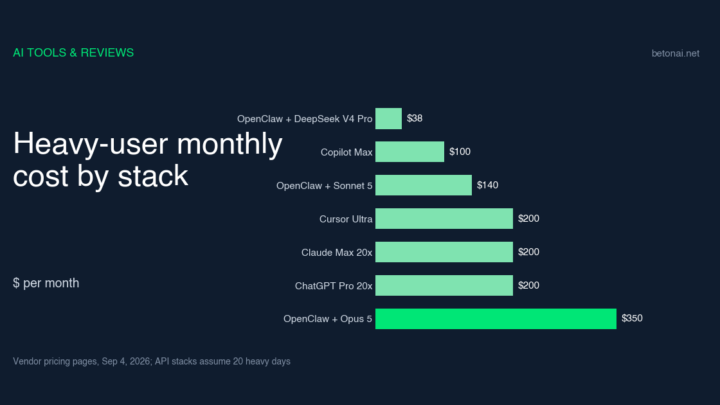
The Power User Stack ($200/month)
For those who want the absolute best of everything — ChatGPT Pro ($200), Claude Max ($100), Midjourney Pro ($60), Cursor Pro ($20). Total: $380/month. But honestly, this is overkill for most people. The $57 solopreneur stack covers 90% of needs at a fraction of the cost.
API vs Subscription: Which Is Cheaper?
For casual users, subscriptions win. For heavy or automated usage, APIs are often cheaper.
| Usage Level | Subscription Cost | API Cost (estimated) | Winner |
|---|---|---|---|
| Light (50 messages/day) | $20/mo | $5-15/mo | API (but less convenient) |
| Moderate (200 messages/day) | $20/mo | $30-80/mo | Subscription |
| Heavy (500+ messages/day) | $200/mo (Pro) | $100-300/mo | Depends on model |
| Automated/batch | N/A | Varies widely | API (only option) |
How to Reduce Your AI Costs
- Use free tiers strategically: Claude Free + ChatGPT Free covers most casual needs. See our complete list of free AI tools.
- Use the right model for the job: Don’t use GPT-4o for tasks that GPT-4o mini handles fine. Match model capability to task complexity.
- Batch your usage: Consolidate AI tasks into focused sessions rather than sporadic use throughout the day.
- Use API for automated tasks: If you’re running automations, API pricing is usually cheaper than subscription-based access.
- Self-host where possible: n8n (automation), Stable Diffusion (images), and Ollama (chatbots) all run for free on your own hardware.
- Annual billing: Most tools offer 15-20% discounts on annual plans. ChatGPT Plus annual saves about $48/year.
Is AI Worth the Cost? ROI Analysis
The question isn’t “how much does AI cost?” — it’s “how much does AI save or earn?”
| Use Case | AI Cost/Month | Value Generated | ROI |
|---|---|---|---|
| Freelance writer (ChatGPT + Claude) | $40 | $3,000-10,000 in client work | 75-250x |
| Developer (Cursor + Copilot) | $30 | $2,000-8,000 in saved time | 65-265x |
| Small business (full stack) | $97 | $3,000+ in labor savings | 30x+ |
| Content creator (writing + images) | $50 | $1,000-5,000 in content value | 20-100x |
For a deeper look at industry-specific AI costs, see our Real Cost of AI by Industry breakdown. And if you’re ready to build your stack, our small business AI stack under $100/month guide has the exact tools and setup.
Frequently Asked Questions
What’s the cheapest way to use AI in 2026?
Completely free: ChatGPT Free + Claude Free + Leonardo AI Free + Grammarly Free gives you writing, images, and editing for $0/month. The first worthwhile upgrade is $20/month for either ChatGPT Plus or Claude Pro, which removes the biggest limitation (daily message caps) for the tool you use most.
Is ChatGPT Plus worth $20/month?
If you use ChatGPT more than a few times per week, yes. The Plus tier gives you GPT-4o (much smarter than the free GPT-4o mini), web browsing, DALL-E image generation, and higher rate limits. For anyone making money with AI, the $20 pays for itself in the first hour of use.
How much should a small business budget for AI tools?
Start at $50-100/month and scale up based on results. A lean stack of ChatGPT Plus ($20) + Claude Pro ($20) + one specialized tool ($10-30) covers most small business needs. Avoid enterprise plans until you have 10+ employees actively using AI. See our detailed small business stack guide for the exact breakdown.
Are API costs predictable?
API costs scale with usage, which can be unpredictable. Set spending limits in your API dashboard (OpenAI and Anthropic both support this). Start with a $20 monthly cap and adjust based on actual usage. For most individuals, subscription plans are more predictable and often cheaper than equivalent API usage.
Will AI costs go up or down in 2026-2027?
Costs have been trending down. GPT-4-class models are now available at prices that GPT-3.5 commanded in 2023. Competition between OpenAI, Anthropic, Google, and open-source alternatives keeps driving prices lower. Expect subscription prices to stay stable ($20/month seems to be the industry standard) while model capability per dollar continues to increase significantly.
How we score: read the methodology