The Real Question Is Where Your Break-Even Sits
Running AI locally versus paying for API access comes down to one number: how many tokens do you process per month? Below a certain threshold, APIs win on total cost. Above it, local infrastructure wins. The threshold varies by hardware choice, model selection, and how you count engineering time. This article gives you the actual numbers for 2026 so you can make the calculation for your specific situation.
What Local Hardware Costs in 2026
The local AI hardware market has matured considerably. Apple Silicon Macs have become the de facto choice for running 7B-70B parameter models without a data center. NVIDIA GPUs remain the choice for teams needing maximum throughput or running 100B+ parameter frontier-class models locally.
| Hardware | Purchase Price | VRAM / Unified Memory | Max Model Size (4-bit) | Throughput (70B model) |
|---|---|---|---|---|
| Mac Mini M4 (16GB) | $599 | 16GB | 7B-13B parameters | 12-18 tokens/sec |
| Mac Studio M4 Max (64GB) | $1,999 | 64GB | Up to 40B parameters | 15-25 tokens/sec |
| Mac Studio M4 Ultra (192GB) | $6,000+ | 192GB | 120B+ parameters | 2-5 tokens/sec (at 120B) |
| RTX 4090 (single GPU) | $1,600 | 24GB GDDR7 | 13B-34B parameters | 40-80 tokens/sec |
| H100 SXM (single GPU) | $15,000-20,000 | 80GB HBM3 | 70B parameters | 200+ tokens/sec |
| 2x H100 server | $40,000-50,000 | 160GB combined | 70B at full precision | 400+ tokens/sec |
The Mac Studio M4 Ultra at $6,000 is the most common choice for small teams wanting to run 70B-class models without GPU cluster complexity. At 2-5 tokens/second for 120B parameter models, it is slow for user-facing applications but adequate for background processing (source: hardwarepedia.com).
Cloud GPU vs API: Another Option
If you want the economics of self-hosting without the capital cost of hardware, cloud GPU rentals sit in between. You run your own model on rented infrastructure. The math is different from both owned hardware and pure API usage.
| Cloud GPU Option | Cost Per Hour | Monthly (24/7) | Effective Token Cost (Llama 3 70B) |
|---|---|---|---|
| Lambda Labs A100 (40GB) | $1.29 | $929 | ~$0.40/1M tokens |
| RunPod H100 SXM | $2.49 | $1,793 | ~$0.20/1M tokens |
| Together AI (hosted inference) | Pay per token | Variable | $0.90/1M (Llama 3 70B) |
| Groq (LPU inference) | Pay per token | Variable | $0.59/1M (Llama 3 70B) |
Cloud GPU rentals for self-managed inference typically land at $0.20-0.50/1M tokens for 70B class models when amortized across a full utilization schedule. Hosted inference APIs for open models (Together AI, Groq, Fireworks) run $0.59-0.90/1M tokens with no infrastructure management required.
The Break-Even Calculation
The core question: at what monthly token volume does owning hardware beat paying API rates?
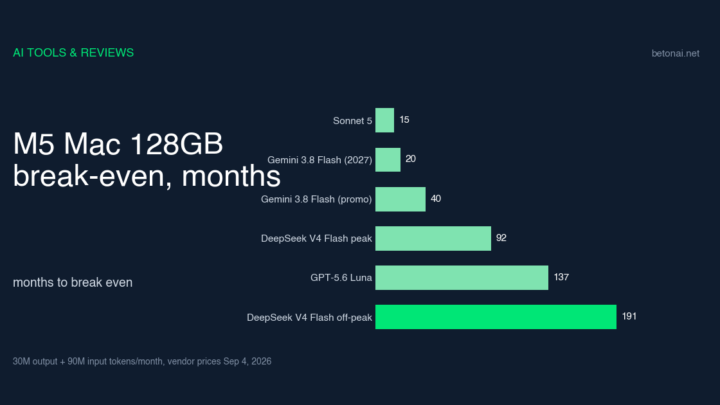
Using a Mac Studio M4 Ultra at $6,000 amortized over 36 months = $167/month hardware cost, plus roughly $30/month electricity at 350W average draw = $197/month total infrastructure cost. That gives you approximately as much capacity as you can push through the hardware continuously. At 3 tokens/second for a 70B model running 24/7, that is roughly 7.8 million tokens per day or 234 million tokens per month.
Comparing against Claude Sonnet 4.6 at $3.00/1M input and $15.00/1M output (assuming 2:1 input-output ratio in typical usage, effective rate around $7/1M blended):
- $197/month hardware vs $7/1M tokens on API
- Break-even: 28 million tokens per month
If you process fewer than 28 million tokens per month, the API is cheaper. Above that, local hardware wins. For a 70B model versus GPT-4o or Claude Sonnet, the quality trade-off favors the API at moderate volumes – but at 50-100 million tokens per month, local hardware produces meaningful savings even accounting for quality differences (source: renezander.com).
| Monthly Token Volume | API Cost (Sonnet 4.6) | Mac Studio M4 Ultra Cost | RTX 4090 (owned) Cost |
|---|---|---|---|
| 5M tokens | $35 | $197 | $55 |
| 20M tokens | $140 | $197 | $55 |
| 50M tokens | $350 | $197 | $55 |
| 200M tokens | $1,400 | $197 | $55 |
| 500M tokens | $3,500 | $197 | $200 (multiple GPUs needed) |
Note: API cost estimates use Sonnet 4.6 blended rates. Local hardware runs open-weight models (Llama 3, Mistral, Qwen) that are not equivalent to Claude Sonnet in quality. The quality gap is the real cost of local inference that the table does not capture.
The Engineering Tax: The Number Most Analyses Ignore
Raw hardware costs are only 30-40% of the true cost of self-hosting (source: sitepoint.com). The rest is engineering time. Setting up a production-grade local inference stack requires:
- Model selection and quantization testing
- Inference server setup (llama.cpp, Ollama, vLLM, or similar)
- API compatibility layer for your application
- Monitoring, alerting, and capacity planning
- Hardware maintenance, driver updates, cooling
- Model updates as better open-weight models release
Industry estimates put this at $500K+ per year in engineering time for a properly managed self-hosted deployment. Small teams of 1-3 people running local models informally have much lower overhead, but also less reliability and no SLA.
When Local Inference Makes Clear Sense
Despite the break-even math favoring APIs at moderate volume, local inference wins clearly in specific scenarios:
- Privacy-sensitive workloads: Medical, legal, or financial data that cannot leave your infrastructure. No token volume calculation needed – local is the only option.
- Extreme volume at good-enough quality: If 500M+ tokens per month at 70B model quality is adequate, local hardware saves $3,000-15,000/month versus premium API rates.
- Development and experimentation: A Mac Mini M4 at $599 is cheaper than a year of serious API usage for a developer running experiments. The unit economics strongly favor local for non-production workloads.
- Latency-critical applications: Local inference on fast hardware (RTX 4090 at 80 tokens/sec) beats API latency for applications where sub-100ms first-token latency matters and the model fits in VRAM.
The Hybrid Architecture
The most cost-effective answer in 2026 for high-volume teams is hybrid: run predictable baseline workloads on local hardware, route to cloud APIs for overflow, frontier model access, and tasks where quality justifies the premium. At 500M tokens per day, a mixed Llama 70B local plus occasional Sonnet 4.6 API calls for complex tasks costs approximately $4,360/month versus $22,500/month for pure API – a 5x difference at that scale (source: spheron.network).
BetOnAI Verdict
The break-even point for local AI versus API access sits around 20-30 million tokens per month for most teams when comparing against premium API rates. Below that, APIs win on total cost once engineering overhead is counted. Above it – particularly above 100 million tokens per month – local hardware or cloud GPU rentals produce meaningful savings. The non-financial case for local is stronger and simpler: data privacy requirements, latency needs, and offline capability are clear wins that do not depend on token math. For everyone else, start with APIs and revisit local infrastructure when your monthly API bill crosses $500-1,000/month and grows predictably.
How we score: read the methodology