Top 100 AI Apps March 2026: The a16z Report Breakdown – Which Ones Actually Make Money
Nik Sai
Bet on AI
Updated
8 min read

Top 100 AI Apps March 2026: The a16z Report Breakdown — Which Ones Actually Make Money
Dissecting Andreessen Horowitz’s latest Gen AI consumer ranking — users vs. revenue, hype vs. hustle
Every quarter, Andreessen Horowitz (a16z) drops their “Top 100 Gen AI Consumer Apps” report, and every quarter the AI industry collectively refreshes the page like it’s election night. The March 2026 edition just landed, and it’s the most interesting one yet — not because of who’s on top (spoiler: it’s still ChatGPT), but because of what’s happening underneath.
The AI consumer app landscape is maturing. We’re past the “wow, it can write poetry” phase and into the “okay, but does anyone actually pay for this?” phase. And the answer, according to the data, is: some do, most don’t, and the ones that do are building empires.
Let’s break it down.
🏆 The Big Headlines
ChatGPT Is Still the 800-Pound Gorilla
No surprise here. ChatGPT continues to dominate the consumer AI space by virtually every metric — monthly active users, engagement time, revenue, and mindshare. OpenAI’s consumer product has become the de facto interface for “using AI” for hundreds of millions of people.
But the report reveals something important: ChatGPT’s growth rate is slowing. Not shrinking — slowing. The easy users have already signed up. The remaining market is either using competitors, doesn’t know they need AI yet, or is locked into ecosystem alternatives (more on that later when we talk about Siri and Gemini).
What’s more interesting is ChatGPT’s revenue per user. OpenAI’s $20/month Plus tier and $200/month Pro tier are generating significant ARPU (average revenue per user), estimated at $4–6 across the entire user base including free tier. That’s real SaaS-grade economics.
OpenClaw: From Open-Source Darling to OpenAI Acquisition
🌟 The OpenClaw Story: Perhaps the most remarkable data point in the entire report: OpenClaw became the most-starred project on GitHub, surpassing React and even the Linux kernel. An AI agent framework — not a language, not a library, not an operating system — became the single most popular open-source project in the world. Then OpenAI acquired it in February 2026 for an undisclosed sum, marking one of the most significant open-source acquisitions since Microsoft bought GitHub.
The OpenClaw story matters for this analysis because it represents a category that a16z’s consumer report historically missed: AI infrastructure that consumers use indirectly. OpenClaw isn’t a consumer app — it’s the plumbing that makes consumer apps possible. Its GitHub stardom reflects developer enthusiasm, but its real value is in the thousands of products being built on top of it.
OpenAI acquiring OpenClaw signals that the “picks and shovels” layer of AI is consolidating. If you’re building on OpenClaw (and many of the Top 100 apps are), your platform risk just went from “open-source community project” to “controlled by the biggest AI company on Earth.” Mixed bag.
📊 Category Breakdown: Where the Top 100 Actually Cluster
28
Productivity & Writing
Largest Category
22
Creative & Media
Fastest Growing
18
Coding & Dev Tools
Highest ARPU
14
Search & Research
Most Competitive
11
Social & Companion
Most Controversial
7
Education & Tutoring
Under-Monetized
Productivity & Writing (28 apps)
The biggest category, and arguably the most commoditized. Every AI company and their VC has a “write better emails” tool. The standouts here are the ones that moved beyond generic writing assistance into workflow integration — tools that live inside your existing apps rather than asking you to switch to a new tab.
Notion AI, Jasper, and Copy.ai continue to lead, but a new wave of verticalized writing tools (legal briefs, medical notes, financial reports) is growing fast. These niche tools charge 3–5x what general writing assistants do because the output is worth more to the user.
Creative & Media (22 apps)
The fastest-growing category, driven by image generation (Midjourney, DALL-E, Ideogram), video (Runway, Pika, Kling), and music (Suno, Udio). This is where the “AI wow factor” still lives. Every month brings a new capability that genuinely feels magical.
The revenue story is bifurcated. Image generation tools have found product-market fit with both prosumers and professionals — Midjourney reportedly generates over $200M in annual revenue with a tiny team. Video tools are earlier in their monetization curve but growing explosively. Music generation is the wildcard: huge engagement, unclear willingness to pay once the novelty fades.
Coding & Dev Tools (18 apps)
The highest average revenue per user by far. Developers will pay $20–50/month for tools that save them hours daily. GitHub Copilot, Cursor, Replit, and Windsurf (Codeium) dominate. The interesting trend: coding assistants are evolving from autocomplete to full “agentic” workflows — tools that can understand your entire codebase, plan multi-file changes, and execute them.
💡 The Money Insight: Coding tools have the best unit economics in all of consumer AI. The user is a professional who directly monetizes the time saved. $20/month for a tool that saves 5+ hours per week is an absurd ROI. If you’re building in the AI space, developer tools remain the surest path to revenue.
Search & Research (14 apps)
The most competitive — and consequential — category. Perplexity leads the AI-native search pack, but Google Gemini’s integration with Search, ChatGPT’s browsing capabilities, and a dozen upstarts are all fighting for the same users. The stakes are enormous: search is the largest digital advertising market on Earth (~$300B annually).
The problem: most AI search tools don’t have a clear monetization path beyond subscriptions. Perplexity charges $20/month for Pro, but the vast majority of users are on free tier. Will AI search eventually run ads? Almost certainly. But the transition will be awkward.
Social & Companion (11 apps)
Character.AI, Replika, and their ilk. Massive engagement — some users spend hours daily talking to AI characters. The metrics are staggering: Character.AI reportedly has users averaging 2+ hours per session. But monetization is tricky. These apps serve a demographic that skews younger and less willing to pay. And the ethical questions (dependency, parasocial relationships, content moderation) create regulatory risk.
💵 The Revenue Reality: Who’s Actually Making Money?
This is the BetOnAI question. Users are vanity metrics. Revenue is truth. Here’s how the Top 100 break down by monetization maturity:
| Revenue Tier | # of Apps | Revenue Model | Examples |
|---|---|---|---|
| $100M+ ARR | ~8 | Subscriptions, enterprise | ChatGPT, Midjourney, GitHub Copilot, Jasper |
| $10M–$100M ARR | ~18 | Subscriptions, credits, API | Perplexity, Cursor, Runway, Character.AI, Suno |
| $1M–$10M ARR | ~30 | Freemium, credits | Various niche tools, emerging platforms |
| Pre-Revenue / <$1M | ~44 | VC-funded growth, unclear | Many social/companion apps, experimental tools |
Let that sink in: 44 of the Top 100 Gen AI consumer apps are generating less than $1M in annual revenue. They’re on the list because of user traffic, not business sustainability. This is the AI bubble’s pressure point — not that the technology doesn’t work, but that turning usage into revenue remains unsolved for nearly half the market leaders.
🔧 Building ON TOP of the Top 100
Here’s where the BetOnAI lens gets interesting. You don’t have to compete with these apps. You can build on them.
The Platform Opportunities
Custom GPTs & ChatGPT Plugins: OpenAI’s GPT Store is still early but growing. Building specialized GPTs for niche use cases (real estate analysis, nutrition planning, legal document review) is essentially free to start and can generate subscription revenue through OpenAI’s revenue sharing program.
Midjourney Workflow Tools: Midjourney generates millions of images daily, but the workflow around it (prompt management, batch processing, style consistency, brand asset management) is largely unsolved. Tools that make Midjourney more useful for professionals have clear willingness to pay.
AI-Powered Course Creation: Combine tools like ChatGPT for content, Midjourney/DALL-E for visuals, ElevenLabs for voiceover, and Runway for video — and you can create educational content at 10x the speed. The meta-play is teaching others to use these tools, which is itself a growing business category.
AI Agent Orchestration: With OpenClaw now under OpenAI’s umbrella, the opportunity is in building vertically-integrated agent solutions for specific industries. A real estate agent assistant, a medical practice coordinator, a restaurant management AI — these are businesses waiting to be built on the agent infrastructure layer.
Affiliate & Revenue Angles
📈 Affiliate Reality Check: Several Top 100 apps offer affiliate programs with meaningful commissions:
- Jasper: 30% recurring commission for 12 months
- Copy.ai: 45% first-year commission
- Writesonic: 30% recurring lifetime
- Notion AI: Credits-based referral program
- Midjourney: No formal program (organic sharing only)
The play: create comparison content, tutorials, and workflow guides. “How I use [Tool X] to do [specific task]” content converts better than generic reviews because it demonstrates actual value.
🔮 What the Report Tells Us About Where AI Is Going
Consolidation Is Coming
The Top 100 has too many apps that do essentially the same thing. In 12 months, expect M&A to reduce the writing tool category by half. The strongest brands and the best unit economics survive. Everyone else gets acqui-hired or dies.
Vertical > Horizontal
The generalist AI tools (ChatGPT, Claude, Gemini) are getting better so fast that any horizontal feature built by a startup today will be a checkbox feature in the foundation models within 6 months. The durable companies are going vertical — deep into specific industries with domain expertise, proprietary data, and workflow integration that generalists can’t easily replicate.
Revenue Models Are Evolving
Pure subscription is giving way to hybrid models: subscription + usage-based credits + marketplace cuts. Expect more apps to adopt “outcome-based pricing” — charging not for access but for results. An AI that helps you write a legal contract charges per contract, not per month. This aligns incentives and unlocks willingness to pay.
The Platform Wars Define Everything
Apple’s new Siri (launching later this year), Google’s Gemini integration, and OpenAI’s expanding ecosystem are the gravitational forces shaping this market. Any consumer AI app that relies on user acquisition through app stores or search is at the mercy of these platforms. The apps that thrive will be the ones that become essential — tools that users seek out by name regardless of what their phone’s default assistant can do.
🎯 The Bottom Line
The a16z Top 100 report for March 2026 confirms what many suspected: the AI consumer market is real, growing, but brutally competitive. ChatGPT’s dominance is a feature of the landscape, not a bug to be disrupted. The money is in niches, developer tools, and creative platforms. Nearly half of the Top 100 haven’t figured out how to make money yet, and they’re running on borrowed time (and VC runway).
For builders: go vertical, charge for outcomes, and build on platforms rather than competing with them. For investors and affiliates: follow the revenue, not the user counts. The best AI businesses of 2026 won’t necessarily be the most popular — they’ll be the ones that figured out how to turn AI capabilities into AI cash flow.
And for the 44 apps on this list that are pre-revenue? Clock’s ticking. The market’s patience for “growth at all costs” in AI is expiring about as fast as the VC checks clear.
Sources & Further Reading
- a16z — “Top 100 Gen AI Consumer Apps, March 2026”
- The Information — “OpenAI’s Revenue Run Rate Surpasses $10B” (February 2026)
- TechCrunch — “OpenAI Acquires OpenClaw, the Most-Starred GitHub Project” (February 2026)
- GitHub — “Trending Repositories” (Accessed March 2026)
- Sacra — “Midjourney Revenue and Growth Estimates” (Q1 2026)
- The Verge — “Character.AI Users Spend Over 2 Hours Per Session on Average” (March 2026)
- Statista — “Global Search Advertising Market Size 2024–2027”
📝 Note: Revenue figures cited are estimates based on publicly available data, analyst reports, and industry sources. Actual figures may vary. App rankings and categories reflect the a16z March 2026 report with additional BetOnAI analysis. This article contains affiliate-related discussion but no affiliate links.
How we score: read the methodology

Nik Sai
More from Nik Sai
Keep reading
All AI Tools & Reviews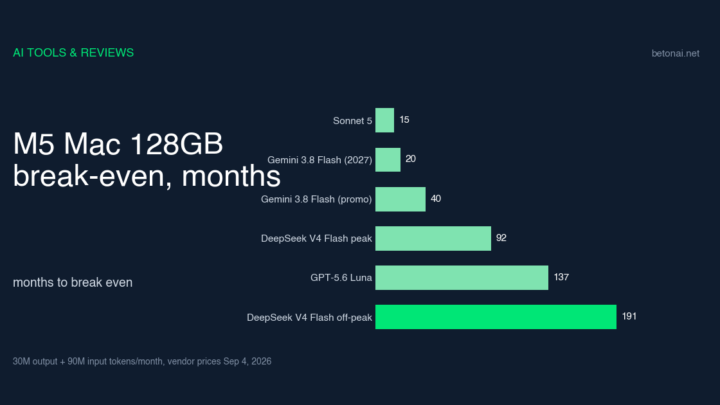
Local AI vs API in 2026: The Exact Token Volume Where a $6,999 M5 Mac Pays for Itself
A $6,999 128GB M5 MacBook Pro beats Sonnet 5 at about 20M output tokens a month and never beats DeepSeek V4 Flash.…
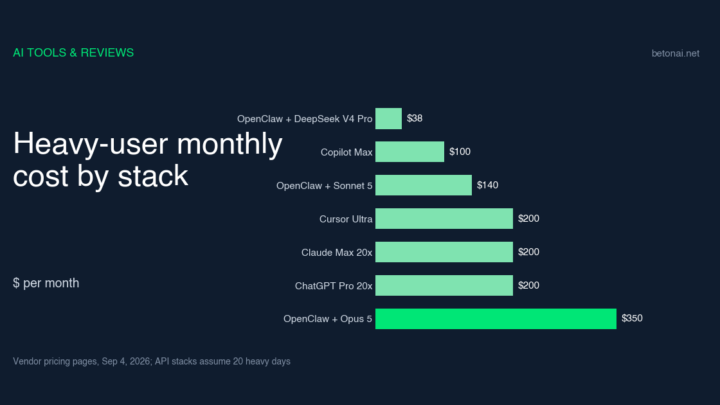
Claude Code vs Cursor vs Codex vs OpenClaw: What the Agentic Coding Stack Really Costs in 2026, and the Hourly Rate That Pays for It
Claude Code, Cursor, Codex, Copilot and OpenClaw priced per month, per heavy API coding day, and the freelance hourly rate that covers…
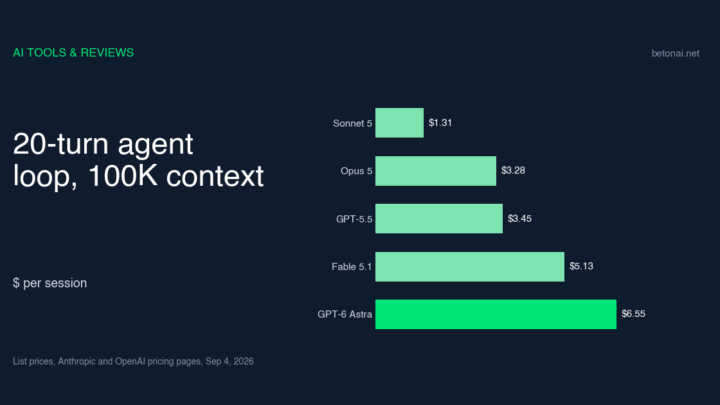
Claude Fable 5.1 vs GPT-6 Astra: Same $60 Sticker Price, Very Different Bill (2026 Cost Breakdown)
Both list at $10 in / $50 out. Fable 5.1 cache reads cost $0.25 vs $1 on Astra. Worked examples show where…