Prices Have Fallen 300x in Three Years. Where Do They Go From Here?
Between early 2023 and April 2026, AI API pricing went through one of the fastest cost reductions of any technology in recent history. GPT-4-class inference cost $30 per million input tokens in early 2023. In April 2026, equivalent or superior capability is available at $1.25-2.50 per million tokens from multiple providers – and at $0.10-0.14 per million from budget options. That is a 95-99% reduction in three years. Understanding how this happened, and where the curve leads, shapes every infrastructure decision you make for the next 12-24 months.
The Historical Price Curve: 2023 to 2026
| Date | Frontier Model | Input Rate (per 1M) | Key Event |
|---|---|---|---|
| March 2023 | GPT-4 (launch) | $30.00 | Frontier model, limited access |
| July 2023 | GPT-3.5 Turbo | $1.50 (halved) | OpenAI cuts 3.5 prices 50% |
| November 2023 | GPT-4 Turbo | $10.00 | New GPT-4 variant, 67% cheaper |
| May 2024 | GPT-4o | $5.00 | Multimodal, 50% cheaper than GPT-4 Turbo |
| July 2024 | GPT-4o mini | $0.15 | Turning point: GPT-4-level quality under $1/M |
| January 2025 | DeepSeek V3 | $0.27 | Open-weight model shocks market on price/quality |
| Mid 2025 | Gemini 2.5 Flash | $0.15 | Google matches GPT-4o mini pricing with 1M context |
| Late 2025 | Claude Haiku 4.5 | $1.00 | Anthropic’s budget tier, 75% below Sonnet |
| Early 2026 | DeepSeek V4 | $0.30 | Improved quality at near-commodity pricing |
| April 2026 | Gemini 2.5 Flash-Lite | $0.10 | New price floor for production-grade inference |
The inflection point was July 2024. GPT-4o mini proved that GPT-4-level capability did not require $5-30/million token pricing. From that moment, the market bifurcated: budget models drove toward commodity pricing floors while frontier models (o3, Claude Opus) maintained premium rates justified by measurably better performance on hard tasks. This bifurcation is now the defining structural feature of the 2026 market (source: tokencost.app, benchlm.ai).
What Drove the 300x Drop
The price reduction was not one thing – it was five forces compounding simultaneously:
1. Hardware efficiency gains: NVIDIA H100 and H200 inference performance improved significantly from 2023-2026 through driver optimization and better batching. The same hardware serves more tokens per dollar over time without a chip upgrade.
2. Model architecture efficiency: Mixture-of-Experts (MoE) architectures (used by Mixtral, DeepSeek, and later GPT-4o) run a fraction of the parameters per token compared to dense transformers. You get similar quality at 20-30% of the compute cost.
3. Open-source competition: Llama, Mistral, and DeepSeek created an open-weight alternative that forced pricing discipline on commercial providers. The number of inference providers serving open-source models grew from 27 in early 2025 to 90 by late 2025 (source: a16z). When Llama 70B performs close to GPT-4 on many benchmarks, OpenAI cannot charge $30/million tokens for comparable tasks indefinitely.
4. Provider competition: Google, Anthropic, xAI, and Mistral all entered the API market with competitive pricing to gain developer share. Every price cut by one provider forces responses from others.
5. Inference optimization: Techniques like speculative decoding, continuous batching, and Flash Attention reduced the compute cost of a single inference call by 40-70% independent of hardware improvements. These are software gains, essentially free improvements applied to existing deployments.
Open Source as the Price Floor
The structural force that makes it difficult for closed-source providers to raise prices is open-weight competition. Meta’s Llama series, Mistral’s models, and DeepSeek are freely available weights that anyone can run. On hosting platforms (Together AI, Fireworks, Groq), they run at $0.22-0.90 per million tokens depending on model size. On self-hosted hardware, the marginal token cost approaches zero.
Research published by Andreessen Horowitz’s LLMflation analysis and by academic economists in late 2025 documents that open-source models are approximately 90% cheaper than closed-source models at equivalent intelligence levels. This creates a structural ceiling on commercial API pricing: once open-weight models reach quality parity on a task category, commercial providers must price near open-source hosting costs to retain that market segment (source: a16z.com).
Gartner’s Forecast: 90% Additional Drop by 2030
In March 2026, Gartner published a forecast: by 2030, performing inference on a 1-trillion-parameter LLM will cost GenAI providers over 90% less than in 2025. Gartner’s forecast is based on hardware efficiency curves (H100 to next-generation accelerators), model efficiency improvements, and infrastructure optimization (source: gartner.com press release, March 2026).
If accurate, a model that costs $3.00/million tokens today would cost under $0.30/million tokens by 2030. The current $0.10-0.15 budget tier would drop to $0.01-0.015 per million tokens.
Where Prices Are Headed in 2027
Multiple analyst sources converge on 20-50% additional price reductions in the 12-18 months ahead:
| Model Tier | April 2026 Price (Input/1M) | Projected 2027 Price | Est. Reduction |
|---|---|---|---|
| Premium frontier (Claude Opus, GPT-5 Pro) | $5.00-30.00 | $3.00-15.00 | 30-50% |
| Mid-tier frontier (Sonnet, GPT-5.4) | $2.50-3.00 | $1.00-1.50 | 50-67% |
| Budget frontier (Flash, 4o mini) | $0.10-0.15 | $0.03-0.07 | 50-80% |
| Open-source hosted (Llama, Mistral) | $0.22-0.90 | $0.10-0.40 | 50-60% |
These are projections, not guarantees. The rate of decline could slow if training costs stop falling, if hardware supply constrains inference capacity, or if providers consolidate and reduce competition. The rate could accelerate if new architectures (state space models, alternative transformers) prove significantly more efficient.
What This Means for Decisions You Make Today
The falling price curve has two practical implications for current AI infrastructure decisions:
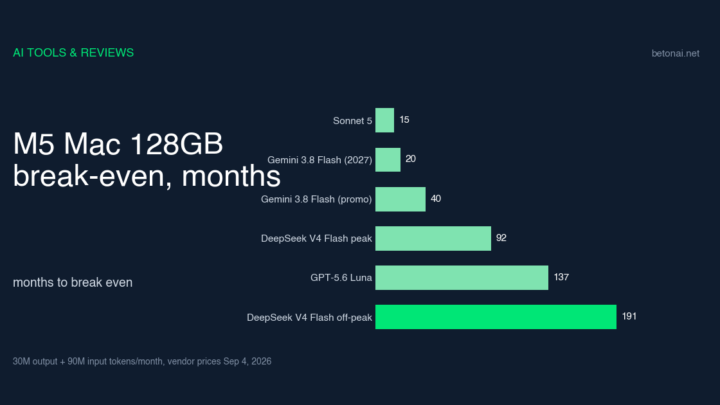
Do not over-index on local hardware economics: The break-even calculation for owning versus renting API access improves every 6-12 months as API prices fall. Hardware you buy today amortizes at declining value as API rates drop toward the cost of self-hosting. Lock in API access flexibility rather than capital expenditure where possible.
Build routing infrastructure now: The models at each quality tier are being replaced regularly. Routing logic that sends tasks to “the cheapest adequate model” needs to be model-agnostic and updated frequently. Teams that hard-code “use GPT-4o for X” will miss cost reductions as cheaper alternatives reach adequate quality. The infrastructure investment in smart routing has increasing returns as the market evolves.
The One Trend That Could Slow Price Drops
The main risk to continued rapid price reductions is that frontier model capability (o3, Claude Opus 4.7) continues to demonstrate value that justifies premium pricing for specific use cases. If agentic AI systems, coding assistants, and complex reasoning tasks remain materially better at $5-30/million tokens than at $0.10-0.30, providers retain pricing power at the high end. The commodity trend affects the middle and bottom of the quality curve most aggressively. At the frontier, providers are competing on capability more than price, and that dynamic could sustain premium rates longer than the historical curve suggests.
BetOnAI Verdict
The AI API pricing curve has been one of the clearest technology cost reduction trends in recent history: 300x cheaper from 2023 to 2026, with Gartner projecting another 90% reduction by 2030. The structural forces driving this – open-source competition, hardware efficiency, MoE architectures, and provider rivalry – are not going away. Budget another 30-60% reduction in equivalent model quality costs by early 2027. Build your AI infrastructure to take advantage of falling prices by using model-agnostic routing, minimizing long-term vendor lock-in, and setting budget alerts rather than committing to specific price assumptions. The developers who position themselves to route dynamically as the market evolves will compound cost savings every year. Those who lock in to specific models or providers will pay a premium for stability as the market continues to move downward.
How we score: read the methodology